Direct answer
For exterior cladding, 304 is a candidate for mild exposure; 316 adds molybdenum for better resistance to chloride pitting and is the usual starting point for low to moderate coastal or deicing-salt exposure. Select the panel finish and every fastening component for the same environment. Splash, persistent salt deposits and unwashed crevices can require a more resistant grade and revised detailing.
The practical difference in 304 vs 316 stainless steel cladding is the corrosion margin available for the wall’s exposure. Type 316’s molybdenum improves chloride resistance, while Type 304 remains a candidate for mild outdoor conditions. A coordinated choice also covers the surface finish, sheltered joints and fasteners.
304 vs 316 at the same exposure
Use 304 where exposure is mild; start with 316 where coastal salt, deicing spray or more demanding urban and industrial deposits are expected. Compare both grades at the intended finish and with the same washing access. Then check the joint: a small fastener or sheltered bracket can face more concentrated deposits than the open panel. IMOA’s exterior selection guidance treats grade, finish, pollution, salt and maintenance as connected decisions.
Same-condition comparison for exterior cladding. On small screens, scroll the table to compare both grades.
| Decision factor | 304 stainless steel | 316 stainless steel |
|---|---|---|
| Molybdenum and pitting | Lower chloride resistance than 316 under comparable conditions | Molybdenum addition improves resistance to chloride pitting |
| Mild outdoor exposure | Candidate when finish, detailing and cleaning suit the site | Greater corrosion resistance; assess whether local exposure calls for it |
| Coastal or deicing salt | Reassess the grade against salt deposition and washing | Common starting point for low to moderate exposure |
| Sheltered, wet crevices | Localized attack can govern selection | Still requires crevice control; severe conditions may need higher resistance |
| Finish and deposits | Specify smoothness, grain direction and cleaning access | The same finish and cleaning checks apply |
| Fasteners and supports | Choose every component for its own exposure and connection duty | A 316 face does not improve the corrosion resistance of other parts |
For other material choices, use the cladding comparison guides. For panel formats and decorative finishes, see stainless steel wall panels. The metal wall coverings guide connects these material decisions to the complete wall system.
What does molybdenum change in 316?
Molybdenum improves resistance to localized chloride attack. IMOA’s Molybdenum-grade stainless steel FAQ identifies the addition as the key improvement over 304 in chloride exposure and more polluted environments. Both grades rely on a thin passive surface film; a chloride-rich wet spot can challenge that protection locally.
Pitting is localized attack into the metal surface. Crevice corrosion develops in a restricted gap, such as beneath a washer or between overlapping parts. ASSDA’s Crevices and Corrosion explains that moisture can enter a narrow gap while circulation remains poor. Oxygen is depleted, chlorides concentrate and the local liquid can become acidic. That joint may become more aggressive than the adjacent open face.
The selection implication is to inspect the least-washed and most water-retentive locations alongside the main elevation. Upgrading the panel to 316 improves the alloy’s resistance, while correcting a moisture-retaining joint addresses the condition driving the attack. Both decisions matter.
When should 304, 316 or a higher grade be considered?
Start with the actual salt, pollution and wetting conditions at each part of the wall. IMOA’s structural stainless guidance places 304 in mild outdoor applications and commonly selects 316 for low to moderate coastal or deicing-salt exposure, moderate industrial pollution or higher urban pollution.
- Mild exposure: consider 304 where corrosive deposits are limited and the intended finish can be kept clean. Include local road-salt spray and industrial sources in that assessment, even inland.
- Salt or more polluted exposure: begin the comparison with 316, then review rain shelter, finish and joints. An open face and an underside beneath a canopy may need different maintenance provisions.
- Severe splash, persistent deposits or difficult cleaning: obtain a higher-alloy assessment together with revised finish and joint details. ASSDA’s coastal guidance identifies situations where 316 needs to give way to greater corrosion resistance.
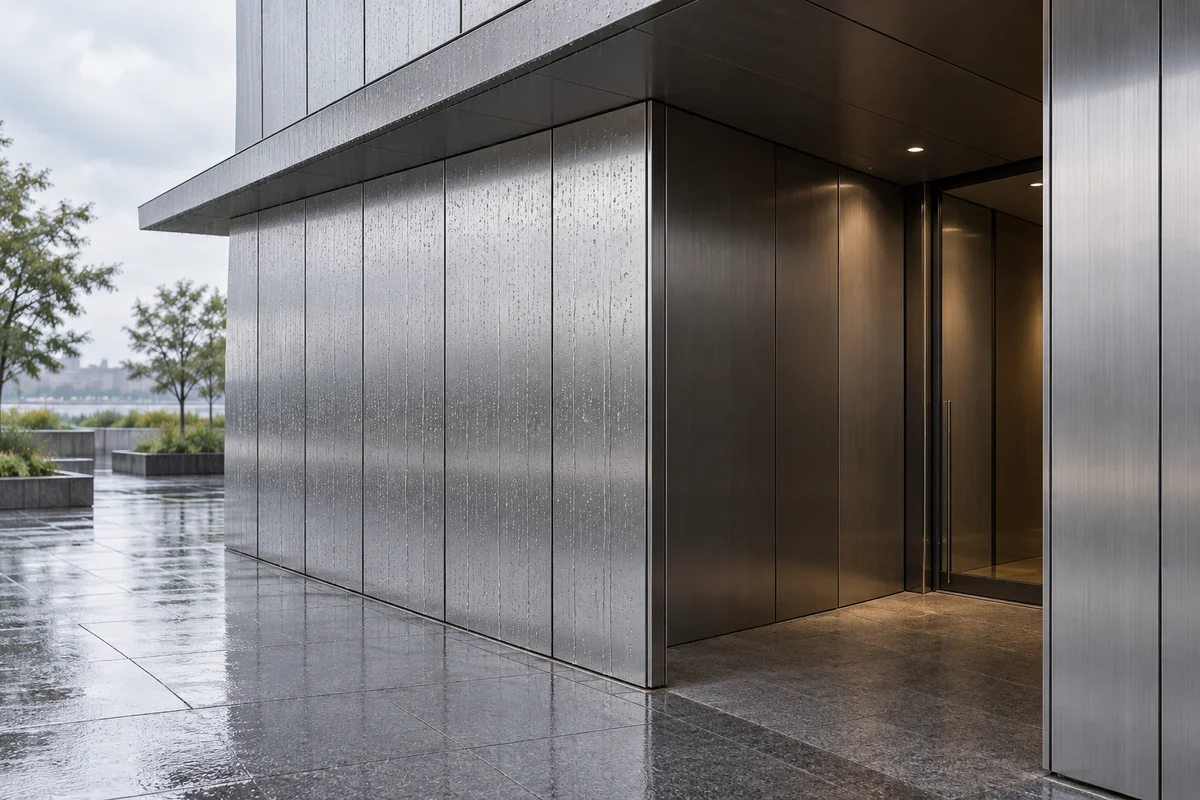
Compare open faces with sheltered returns: reduced rain washing can leave deposits in place longer.
A coastal address is a prompt to investigate deposition and washing. Wind, topography, shelter and splash affect the wall’s exposure, so a single distance from the shoreline cannot settle the choice. Record the location of returns, soffits, brackets and recessed fixings on the elevation drawings; these are easy to miss when reviewing only the front-face sample.
How do finish roughness and rain washing affect the choice?
Specify the actual surface condition as well as the grade. Smoother stainless surfaces tend to retain less contamination. In FAQ 6 — Preventing Coastal Corrosion (Tea Staining), ASSDA recommends a roughness below about 0.5 µm Ra for mechanically abraded surfaces. Ra describes average surface roughness; apply this recommendation to the specified finishing process and obtain a measurement for the proposed surface.
A “No. 4” or “brushed” appearance label leaves the roughness question open. Agree the finish sample, measured roughness and grain orientation together. IMOA explains that vertical grain is more readily washed by rain and collects less dirt than horizontal grain. This is especially useful on exposed exterior faces.
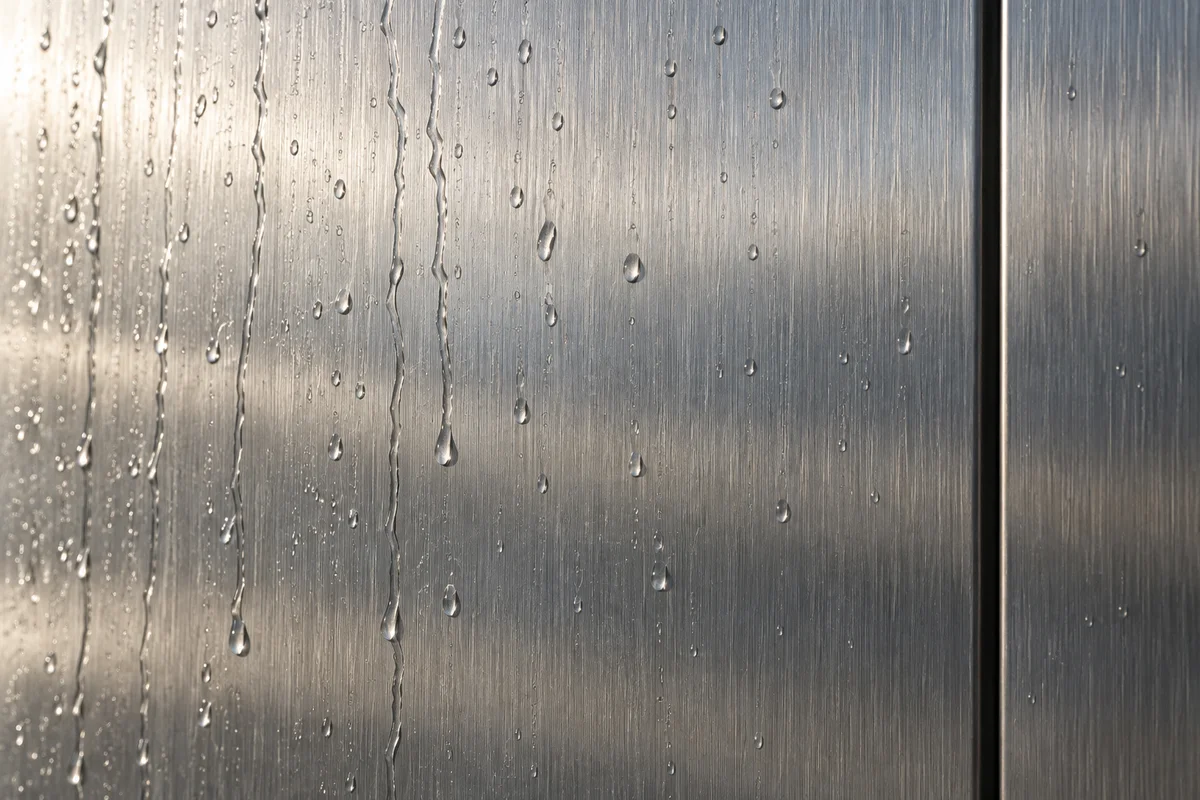
Vertical grain helps rain wash the face; verify the specified roughness separately from the visual finish sample.
Sheltered surfaces need deliberate cleaning access because rain may never reach them. Set the washing plan around local deposits and the approved maintenance instructions, including the undersides and concealed-access locations. The metal panel cleaning guide helps organize the cleaning information to retain.
Fabrication cleanliness is part of the same decision. Protect the stainless from carbon-steel swarf and contaminated tooling, and specify the required treatment of weld heat tint. A grade certificate identifies the alloy; the delivered surface condition determines what reaches the wall.
Which fasteners suit coastal stainless cladding?
Select each fastening component for exposure, then verify its connection duty. Anzor’s The DO’s and DONT’s of Stainless Steel Fasteners recommends 316 over 304 for corrosive or coastal environments. Apply that component-level check to bolts or screws, nuts, washers and brackets, including parts hidden behind a 316 panel.
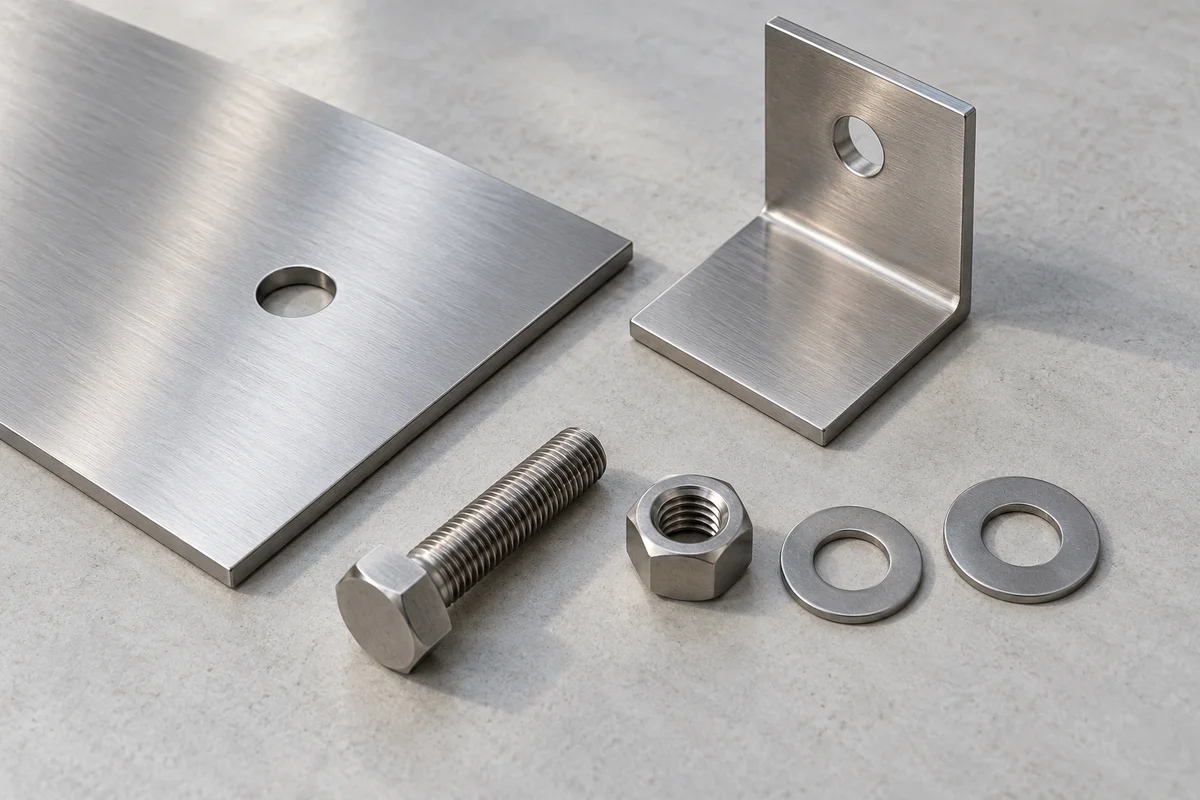
Record the alloy and product designation for each fastening part, then verify the assembled connection’s load and movement requirements.
Mixing 304 and 316
Passive 304 and passive 316 have a small potential difference. ASSDA’s Technical FAQ 1 — Galvanic/Dissimilar Metal Corrosion therefore treats this pairing as generally acceptable from a galvanic perspective. The remaining question is whether each component resists its own local exposure: a sheltered 304 washer can still be vulnerable to chlorides beside a 316 panel.
A 316 fastener can be paired with a suitable 304 panel, but it does not upgrade that panel’s chloride resistance. Keep corrosion selection separate from the fastener’s documented strength, substrate suitability, movement allowance and installation requirements.
Carbon steel, galvanized parts and isolation
A small carbon-steel or galvanized fastener attached to a large stainless surface deserves particular attention when the joint is wet. ASSDA explains that galvanic attack consumes the more active material: the zinc coating or carbon steel can corrode faster while coupled to stainless. The relative wetted areas and the conductivity of the moisture influence the severity.
Electrical isolation must address the whole contact path. A washer beneath the head leaves a connection if the shank touches the hole or the panel touches a dissimilar-metal support. Suitable strips, sleeves and washers can separate these contacts. Paint and the stainless passive film are unreliable as electrical barriers.
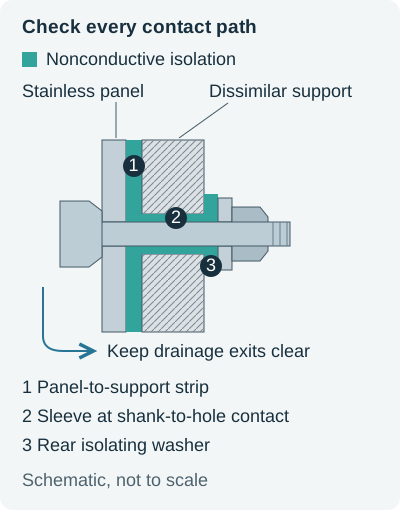
Check the panel-to-support, shank-to-hole and rear washer contacts together. Coordinate these barriers with water exclusion and drainage. Schematic, not to scale.
Isolation and crevice control belong together
Specify compatible, nonconductive isolation materials and review where they touch the metal. ASSDA’s crevice guidance explains that a tight metal-to-plastic gap can itself retain aggressive moisture. Some carbon-filled rubber and graphite-containing products can also conduct electricity.
Coordinate durable seals where the joint relies on water exclusion, and maintain the cladding system’s intended drainage exits. Sealants that separate from the surface or shrink can create new crevices. The selected joint detail must reconcile isolation, moisture control and movement; use the metal cladding corrosion guide for the broader interfaces between metals.
What do brown marks around fasteners tell you?
Locate the affected material before deciding how to repair the mark. Brown discoloration around a hole can accompany several different problems:
- Deposits or chloride-related staining on stainless: review salt exposure, finish, shelter and washing history.
- Transferred iron or rust runoff: investigate nearby steel cutting, contaminated tools and corroding adjacent parts.
- Localized attack or fastener metal loss: inspect the hole, crevice and fastening component, especially where marks recur.
ASSDA describes tea staining as cosmetic, but color alone cannot establish the condition of a connection. Pits, recurring localized attack or loss of fastener section call for qualified inspection before treating the issue as an appearance repair. A rough 304 face with carbon-steel rivets in salt exposure combines multiple risks; the observed cause determines the correction.
Cladding exposure and fastener selection checklist
Complete this record for each distinct exposure zone before releasing the cladding package. Keep the finish sample, material documentation, connection detail and maintenance plan together so that a substitution can be checked against the same conditions.
Record the project input and the resulting decision for each item. Scroll horizontally on a narrow screen.
| Item to record | Decision to close |
|---|---|
| Salt and pollution sources | Identify coastal aerosol, deicing spray, industrial deposits and direct splash; select the grade for those conditions. |
| Rain washing and shelter | Mark open faces, returns, soffits and sheltered fixings; assign cleaning access to each. |
| Panel grade | Record 304, 316 or the higher alloy selected for severe exposure, with material documentation. |
| Finish and roughness | Record the process, measured Ra where applicable, sample approval and grain direction. |
| Bolts, screws, nuts, washers and brackets | Record each alloy and product designation; check hidden components as well as exposed heads. |
| Support metal and isolation | Trace panel, shank and washer contact paths; select compatible barriers where required. |
| Crevices, seals and drainage | Resolve water-retaining gaps and durable seal details while preserving intended drainage. |
| Fabrication condition | Specify contamination controls, weld surface treatment and delivery inspection. |
| Connection performance | Obtain the product-specific load, substrate, movement and installation requirements from the responsible designer and supplier. |
| Maintenance responsibility | Name the responsible party, access method and approved washing instructions for every exposure zone. |
Use the completed record to compare a 304 and a 316 proposal on equal terms. Where exposure demands greater resistance, change the alloy selection together with the finish, joint or cleaning provisions that created the concern.
Frequently asked questions
Can I use 316 fasteners with 304 stainless steel panels?
Passive 304 and 316 are generally galvanically compatible. A 316 fastener can be suitable where its own exposure requires it, but the 304 panel still needs adequate chloride resistance. Check the bracket, washer, substrate and connection design too.
Is 316 stainless steel suitable next to seawater?
316 is commonly selected for low to moderate coastal atmospheric exposure. Direct splash, persistent deposits, sheltered joints and poor cleaning access can justify a higher-alloy assessment. Record the actual wetting and washing conditions before releasing the material.
Does a No. 4 finish meet the roughness recommendation?
The finish name alone does not establish measured roughness. For mechanically abraded surfaces, ASSDA recommends roughness below about 0.5 µm Ra to reduce deposit retention and coastal staining risk. Obtain the finish measurement and agree grain direction as well as appearance.
How far inland can 304 be used safely?
Distance from the coast is only a screening input. Windborne salt, deicing spray, industrial deposits, shelter and cleaning change the exposure at the wall. Select 304 for assessed mild conditions rather than using a single distance as the acceptance rule.
Sources
- Molybdenum-grade stainless steel FAQ — International Molybdenum Association
- FAQ 6 — Preventing Coastal Corrosion (Tea Staining) — Australian Stainless Steel Development Association
- Technical FAQ 1 — Galvanic/Dissimilar Metal Corrosion — Australian Stainless Steel Development Association
- Stainless Steel Inspires Design Metamorphosis — Corrosion Resistance — International Molybdenum Association
- The DO’s and DONT’s of Stainless Steel Fasteners — Anzor
- Crevices and Corrosion — Australian Stainless Steel Development Association