Direct answer
After a metal facade is finished, walk it without removing panels. Record drainage, joints, surface condition, and loose exposed items against that project's operation and maintenance documents, with a photo, the responsible person, and the recheck time those documents set. A bracketed sample interval in a specification template is not the interval for the building. Copy the record on this page and hand it over.
Key takeaways
- Walk the finished wall without opening or removing panels.
- Take the inspection interval from this project's O&M. Leave the recheck date blank when the O&M sets none.
- Each line needs a location, the original requirement, what you found, a photo, the responsible person, and the recheck time.
- Copy the record and give it to the person the documents name. Cleaning methods and repairs are outside this page.
| Criterion | Typical range | Note |
|---|---|---|
| Drainage | Visible outlets and the base | Record blockage or ponding you can see. Do not open the wall. |
| Joints | Exposed flashings and sealants | Record gaps and displaced trim. Do not name a sealant product. |
| Surface | The face you can see | Record stains, cloudiness, scratches, and leftover film. |
| Loose items | Exposed accessories | Record what is displaced or missing. Do not remove panels. |
| Recheck date | From this project's O&M | Leave blank when the documents set no date. |
Without a written record, the next person inherits an unmarked wall, and any damage you saw is no longer tied to a place or a photo. This metal wall panel maintenance checklist is the record to copy after the facade is finished.
Walk the wall without opening it. Write down drainage, joints, the surface, and loose exposed items. Quote the requirement from the operation and maintenance documents. Name the person those documents make responsible. Then copy the record and hand it over. The page sits in the design specification guides, alongside the rest of the metal wall coverings library.
Read the O&M before you set a date
MetalTech-USA’s 2015 specification for section 07 42 13, Metal Wall Panels, is a template. On page 10, article 3.6 tells the specifier to coordinate maintenance with closeout submittals and with operation and maintenance data. The section numbers in that sentence sit in brackets. The same article says to maintain the system in accordance with the manufacturer’s instructions, and it puts “and terms of warranty” in brackets too. Those brackets are placeholders in a master template rather than an executed warranty for your wall.
The inspection line in article 3.6 says to inspect the panels and exposed accessories every [6] months for proper drainage, the integrity of flashings and sealants, and the overall condition of the wall panel system. The 6 is a sample inside brackets. It is the specifier’s blank, not an industry period. Copy the period your own documents state. If they state none, do not insert 6 months.
Common mistake: Pasting that bracketed 6 months, or a cleaning interval from another product, onto every metal wall.
The Metal Construction Association’s February 2024 bulletin covers cleaning of metal composite material panels with painted, anodized, or natural finishes. It describes semiannual cleaning as the usual practice, or more often in a difficult environment. That is cleaning guidance for those finishes. It is not an inspection interval for steel siding, single-skin panels, a rainscreen, or any system the bulletin does not cover. The bulletin says it is general information, not a warranty, and that each metal composite material manufacturer publishes further recommendations. Cleaning methods stay in those instructions. The wash for a named finish is on the cleaning metal wall panels page. This checklist does not pick a cleaner.
Klauer’s page on steel siding tells owners of that siding to clean about once a year and to look for blemishes, scratches, or discoloration at that yearly check and after storms. That is advice about Klauer steel siding. It does not set the interval for aluminum, zinc, copper, or metal composite material.
Before the walk, put these items in the record header:
- The manufacturer’s maintenance instructions from closeout. The MetalTech template lists them as a closeout submittal, next to warranty documentation.
- The project’s operation and maintenance data. Article 3.6 points the specifier at that data. The section number is bracketed in the template.
- A maintenance contract only if the project has one. The template tells the specifier to provide a separate contract for maintenance and repair. Its note says a service agreement that is not paid in advance should stay separate from the construction contract. Write the contract name only when you hold the document.
- Exposure conditions the documents already name. If plants are touching the wall, record that location. Klauer tells owners of its steel siding to keep plants from rubbing the siding. Do not turn a visible condition into a frequency.
Always cross-check general industry guidance against the project’s approved shop drawings and closeout operation and maintenance manual. When they differ, follow the project-specific closeout documents and note the variance on the record.
Takeaway: The recheck date comes from your documents. A blank in a 2015 template is not a schedule.
Walk the face of the wall
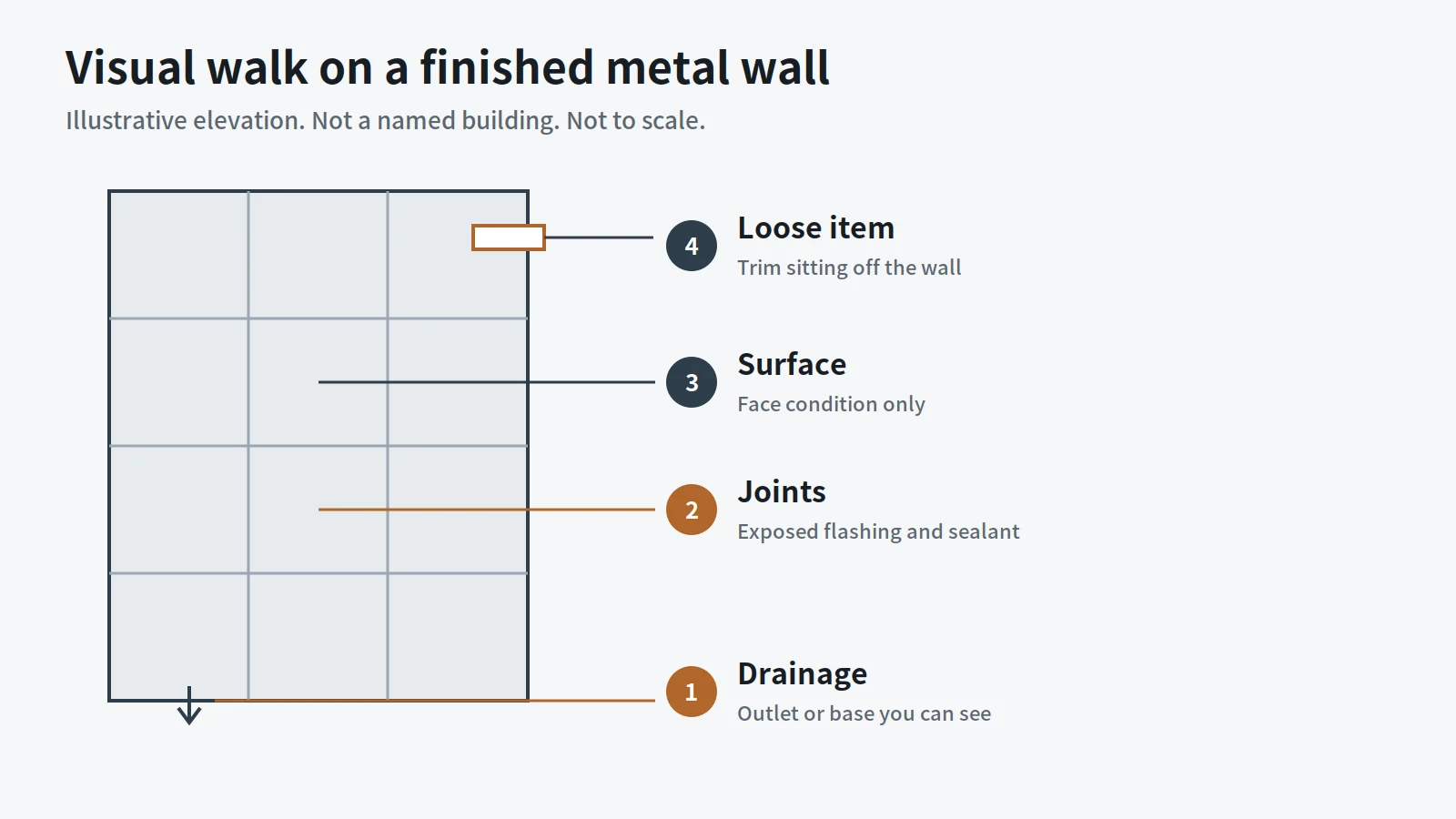
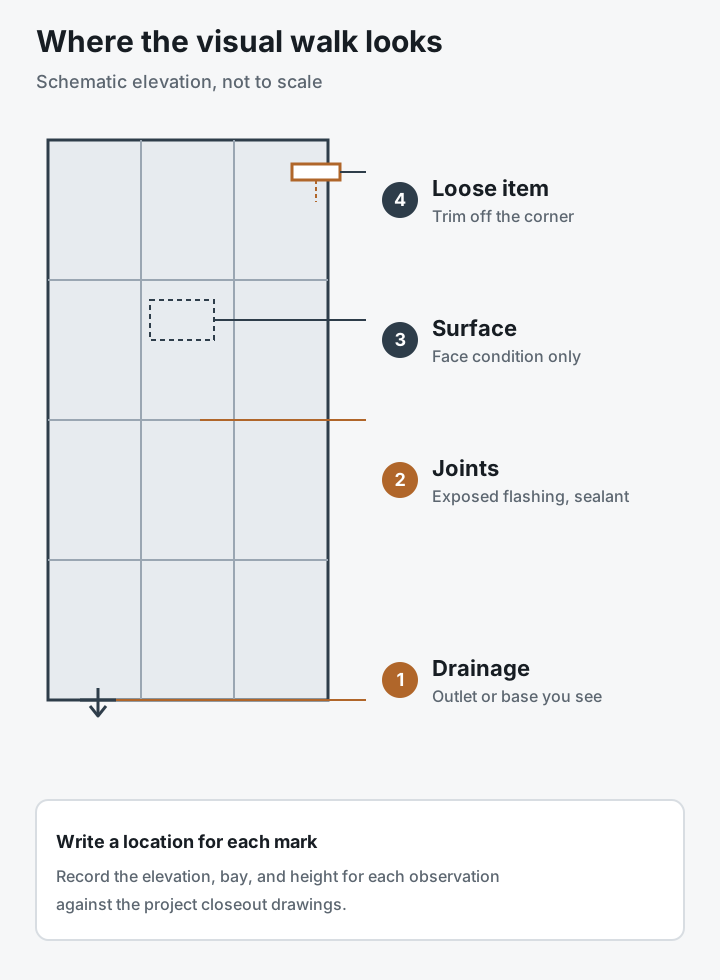
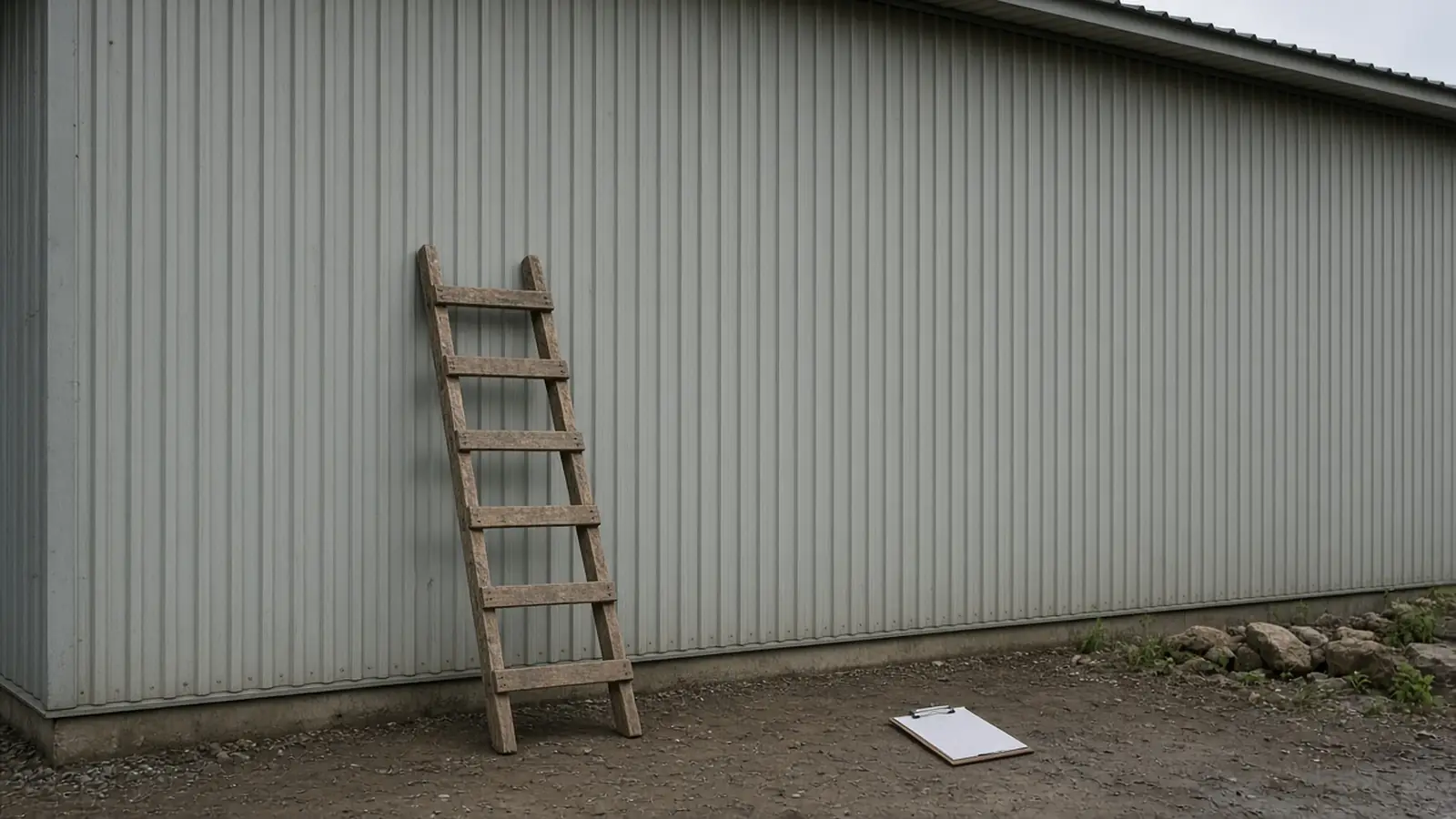
Stay on a visual walk. Article 3.6 is about drainage, flashings, sealants, and the overall condition of the panels and exposed accessories. Use the four marks below. The diagram is schematic and not to scale.
On a phone, swipe the table horizontally to see the last column.
| What you look at | What you write | What you leave alone |
|---|---|---|
| Drainage | Where water is supposed to leave, and whether the outlet, weep, or base you can see is blocked, ponding, or clear | The cavity behind the face |
| Joints | Exposed flashings and sealants: gaps, displaced trim, and pieces missing from the face | Any sealant name or repair description |
| Surface | Soil, stains, a cloudy or whitened face, scratches, or film still stuck to the panel, with the location | Cleaner choice and coating choice |
| Loose items | Exposed trim or accessories that sit off the wall, or pieces missing from where the elevation shows them | The panel itself. Do not take it off |
Takeaway: Four visible items, each with a location. The original requirement still comes from your documents, not from this table.
Leave the wall closed
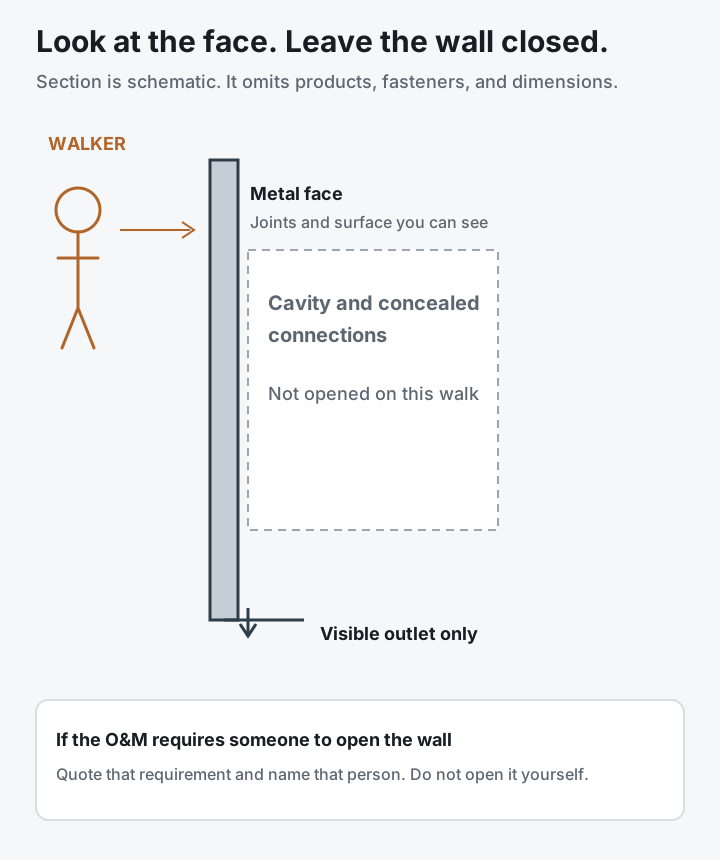
A condition behind the face is outside this walk. Do not unclip, unhook, or unscrew panels to inspect the cavity. If the operation and maintenance documents require a named party to open the wall, quote that requirement and name that person. Do not perform the opening from this page.
Other topics already have their own pages. Use them when the note on your record needs a place to go, and keep the diagnosis off this checklist:
- Waviness that someone suspects is oil canning belongs on the oil canning page. Here, write the location and keep the photo.
- Corrosion questions belong on the metal cladding corrosion page. Do not name a coating system on this record unless your documents already name it.
- Finish identity, before anyone cleans or touches the face, belongs on the metal panel finishes page.
- The handover that was supposed to include maintenance instructions is on the metal wall panel installation page.
That bulletin’s surface notes stay inside metal composite material. It says heavy abrasion on an anodized face can look cloudy or whitened, and that natural copper or zinc faces change and should not be damaged while someone is cleaning. If you see a cloudy anodized face or a marked natural metal, record the location and the finish name from your documents. The metal composite material panels page is system context for that material. It is not a cleaning procedure.
Klauer’s steel-siding page says that for major debris or damage the owner should call a siding professional, and that bare steel is a case in which that professional talks about replacement. This page does not describe how to remove or replace a panel. Record the location and the photo. The steel wall cladding page is material context, not a repair method. Klauer’s comments on painting over scratches are not repeated here.
Takeaway: The walk records the face. Opening, cleaning, and repair stay with the person the documents name.
Put each problem on the same line as the person who acts
Metal wall panels problems and solutions belong on one line of this record: what you found, and the person who has to act. The path next to a problem is that person and the recheck time. It is not a repair recipe.
On a phone, swipe the table horizontally to see the last column.
| If you see this | Write this | Hand the line to |
|---|---|---|
| Water sitting at the base, or an outlet you can see that is blocked | The location, what the documents say drainage should do, and a photo | The person named for the wall or for drainage |
| An open joint, or a flashing that has moved | The location and a photo. Leave the requirement blank if the documents never mention that joint | The person named for the wall |
| A scratch, a stain, or a cloudy face | The location, the finish name from the documents, and a photo | The person named for the finish |
| Trim or an accessory sitting off the wall | The location and a photo | The person named for repair |
If no person is named, write “not named in the documents on hand.” That gap is part of the record.
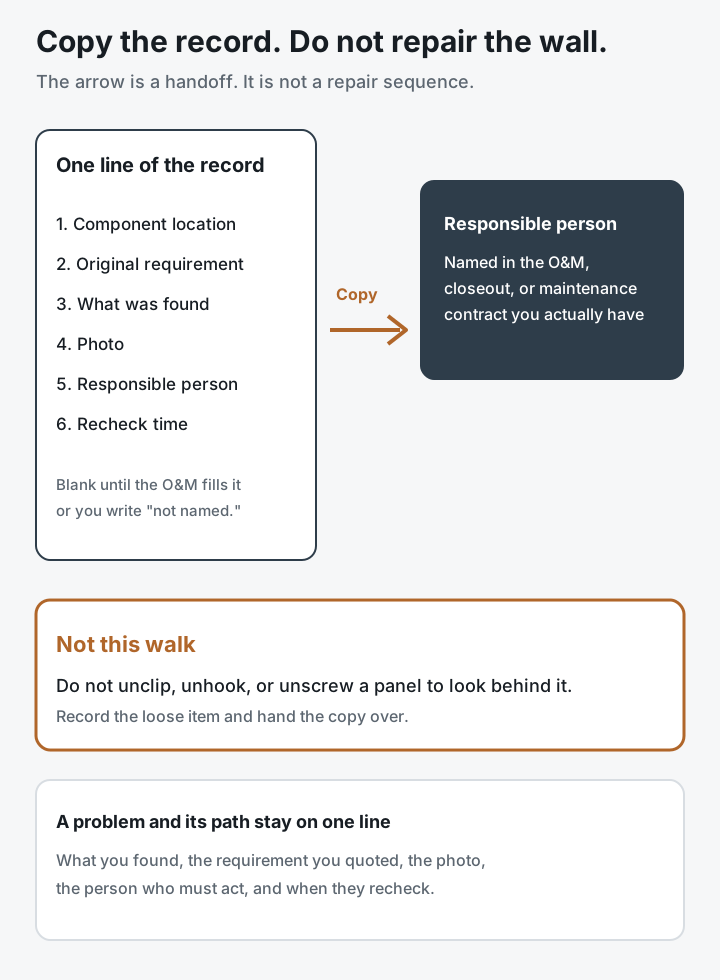
Takeaway: A problem without a quoted requirement and a named person is still worth copying. Leave the responsible-party field open until confirmed in the closeout documents.
Copy this inspection record
The block below is the record. It is the text on this page. Select it and copy it. Keep the copy with the operation and maintenance documents. Add rows when one elevation has more than one outlet or more than one open joint.
METAL WALL PANEL INSPECTION RECORD

Building:
Elevation or area:
Date of walk:
Walker:
Documents used (title and date):
Exposure notes from those documents or from what you can see:

Item | Location | Original requirement (quote the O&M) | What was found | Photo | Responsible person | Recheck date
1 Drainage | | | | | |
2 Joints, exposed flashings, and sealants | | | | | |
3 Surface | | | | | |
4 Loose or displaced exposed items | | | | | |
5 Add rows as needed | | | | | |

Handed to:
Date handed over:
Copy this inspection record and give the copy to the responsible person named in your documents. If those documents name no one, copy the record anyway and write “not named” in the responsible-person field.
Specification checklist
- Collect the manufacturer's maintenance instructions from closeout.
- Collect the project's operation and maintenance data.
- Copy the inspection interval only if those documents state one.
- Note exposure conditions the documents or the site already show.
- Walk without removing panels.
- Photograph each finding in place.
- Name the responsible person the documents actually name.
- Leave the recheck date blank when the documents set none.
- Copy the record and hand that copy over.
Frequently asked questions
How often should metal wall panels be inspected?
There is no single interval in the documents behind this page. The 2015 MetalTech template puts the number of months in brackets and shows 6 as a sample for the specifier to replace. The Metal Construction Association's February 2024 bulletin describes semiannual cleaning for metal composite material finishes, which is a cleaning note, not an inspection rule for every metal wall. Klauer's steel-siding page speaks of a yearly look and a look after storms for that siding. Use the interval in your operation and maintenance documents. If they set none, leave the recheck date blank.
What should I do when a metal wall panel looks loose?
Record the location, quote any original requirement you can find, take a photo, and name the responsible person. Do not remove the panel. This page does not give a repair sequence.
Can this checklist replace the manufacturer's maintenance instructions?
No. The record is a way to write down what those instructions require and what you saw. When the instructions and this page differ, follow the instructions that belong to your system and note the difference on the record.
Sources
- Metal wall panels, section 07 42 13, article 3.6 Maintenance (2015 specification template) — MetalTech-USA Accessed October 12, 2026.
- Cleaning metal composite material panels, not a one-time effort (technical bulletin, February 2024) — Metal Construction Association Accessed October 12, 2026.
- Maintenance Tips for Steel Siding — Klauer Manufacturing Accessed October 12, 2026.