Direct answer
A flat-lock metal panel is a small flat panel whose folded edges interlock with its neighbors. The term describes that seam, not the wall behind it. The manufacturers reviewed here state different backing, use either a separate clip or an attachment built into the panel, and list different layouts, so confirm each condition from the chosen system's current documents.
Key takeaways
- Flat-lock names the folded, interlocking edge, not the backing or the full wall assembly.
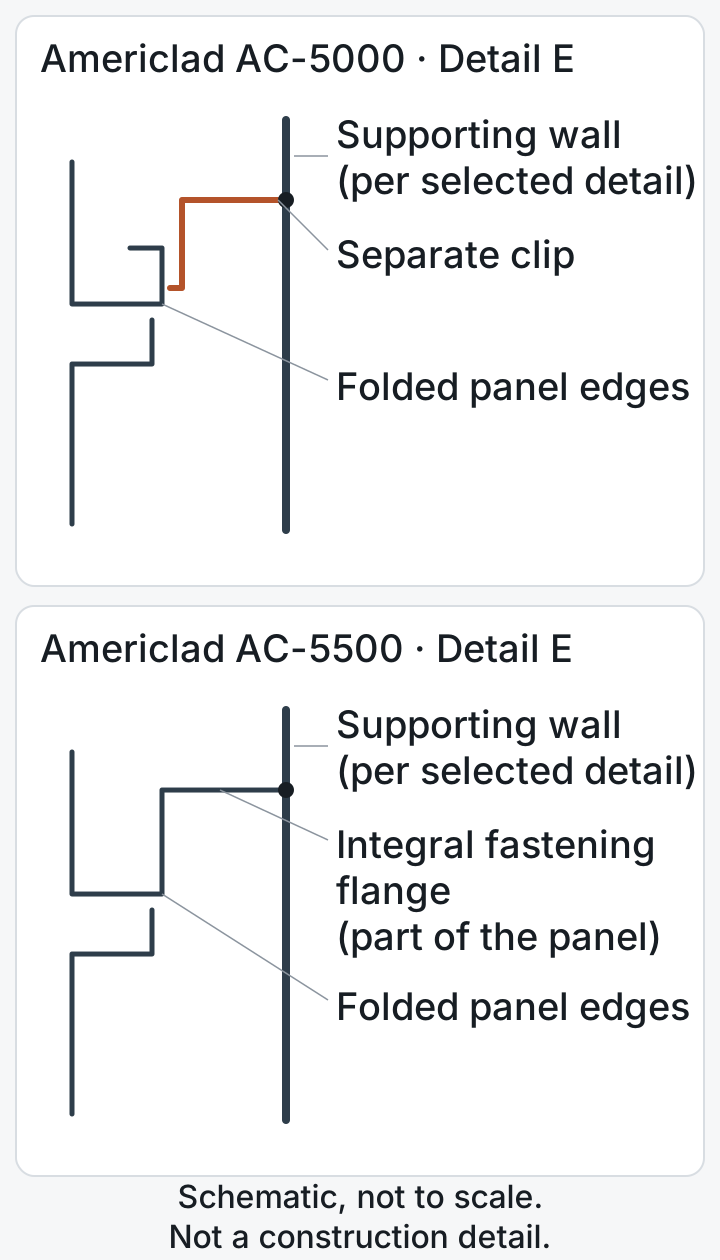
- Americlad AC-5000 details a separate clip; AC-5500 details an integral fastening flange.
- VMZINC states a continuous vented substrate; DMI gives plywood sheathing as one solid-substrate example.
- A manufacturer's "substrate" list may mean panel metal, not the wall backing.
- Fill the checklist from the selected system's own drawings before approving a submittal.
A “flat-lock” label on a drawing means the panel edges fold and interlock, and nothing more. Approve it on that word alone and the backing, the clip and the layout may belong to the wrong system. This guide sits in the metal wall panel systems section and compares what five named systems actually state, so you can ask for the right documents before a submittal is approved.
What does “flat-lock” actually describe?
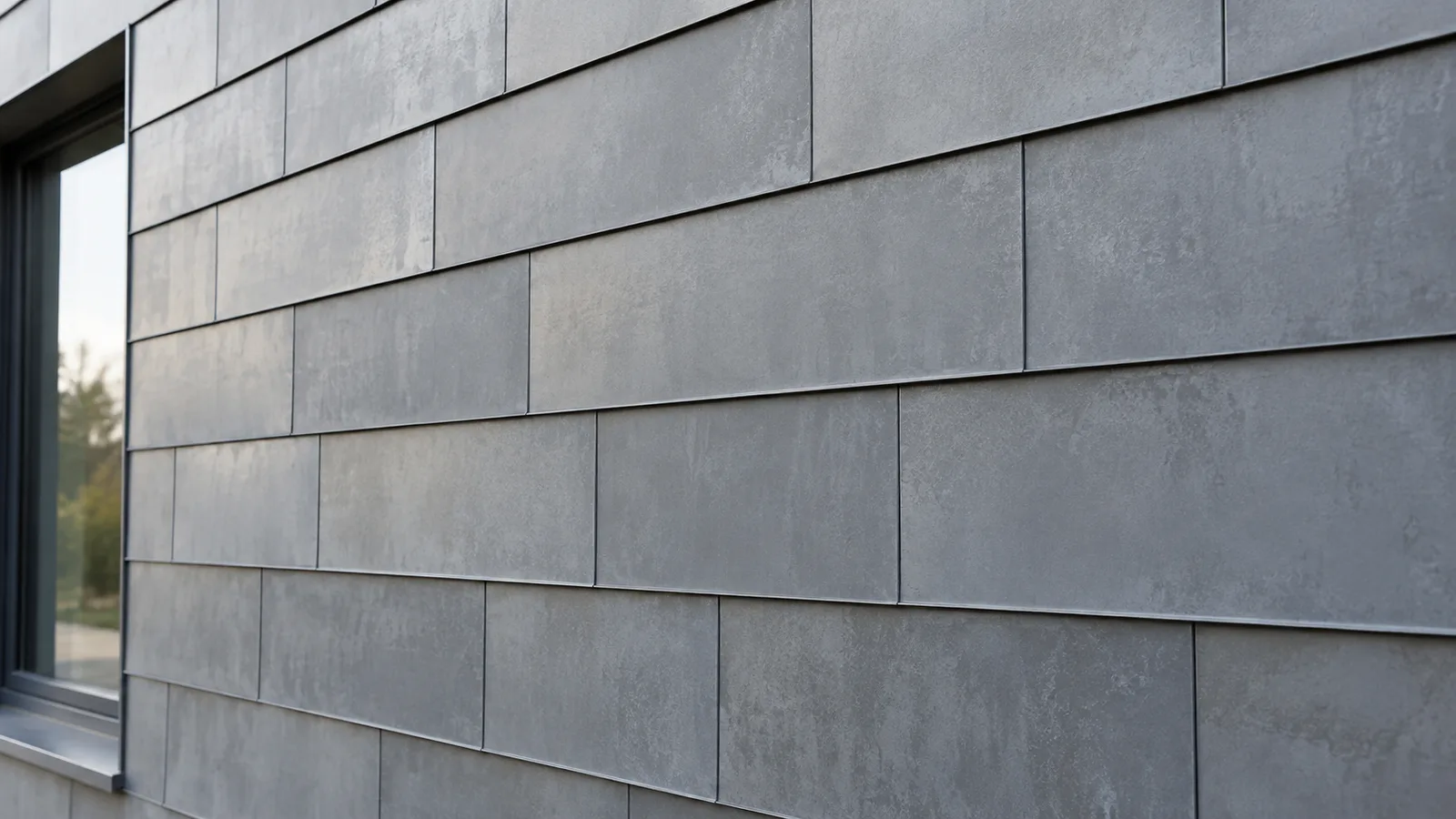
Flat-lock describes a seam: each small flat panel has folded edges, and those folds hook into the folds of the panels around it. VMZINC describes its panels, “sometimes known as shingles,” as having hems that interlock and are held with cleats. Americlad describes an interlocking fold on all four sides, and DMI calls its version a shingle-style panel system.
Keep three things apart when you read a product sheet:
- The seam: the folded, interlocking edge that gives the system its name.
- The panel metal: zinc, copper, aluminum, stainless or coated steel, chosen on the materials side of the metal wall coverings map.
- The wall assembly: backing, water control, any ventilation, the attachment part and its fasteners, and the edges and openings.
Only the first is settled by the word flat-lock. That is also how flat-lock differs from metal cassette panels, which are folded trays on clips or rails, and from single-skin metal panels, which can be large sheets fixed in several ways.
Takeaway: Treat flat-lock as a seam type, then confirm the wall assembly separately.
How do the named systems compare?
Four manufacturers were reviewed, covering five named systems; Americlad publishes two. VMZINC and Americlad describe panel edges that interlock, and DMI calls its version shingle-style, while Millennium Forms says only that its panels overlap and use clips. Beyond that, the systems differ on almost everything a specifier must confirm next. Where a page does not answer a question, the cell says so; a blank there is a document to request, not a feature the system lacks.
| System | Attachment as stated | Backing or support stated | Layouts stated | Still to obtain |
|---|---|---|---|---|
| VMZINC US Flat Lock | Cleats hold the interlocking hems to the substrate | Continuous vented substrate | Horizontal and vertical; square, diamond and rectangular panels | Technical drawings (sent by email on request; not reviewed here) |
| Americlad AC-5000 | Traditional clip-style; Detail E shows separate stainless steel flat lock clips | Detail E note names load-bearing wall components and says gypsum board and cement board are not structural | Horizontal or vertical | Current detail revision; fastener, vent mat and membrane are marked "not by Americlad" |
| Americlad AC-5500 | Clip integrated in the panel; Detail E labels an integral fastening flange | Same note as the AC-5000 detail | Horizontal or vertical | Current detail revision; same items supplied by others |
| DMI FLAT-LOCK (FLPA) | Integrated concealed clips (geometry not shown on the page) | "Solid substrates like plywood sheathing," given as an example | Vertical, horizontal or diagonal (diamond); variable joint staggering | Documents in DMI's Submittal Builder (registration required; not reviewed here) |
| Millennium Forms Flat Lock | "Overlapping metal panels that utilize clips"; separate or integrated not stated | Not stated on the page reviewed | Not stated on the page reviewed | Linked flat lock details, standard dimensions and wall flashing files (not reviewed here) |
Panel metal choices also differ by maker, from zinc and copper to aluminum, stainless steel and coated steel. Read the metal-specific limits in the zinc, copper, aluminum and stainless steel guides; the matrix above does not rank them.
Takeaway: Copy the matrix row for your chosen system and fill every “not stated” cell from its own documents.
Separate clip or integral fastening flange?
Not every flat-lock system uses a separate clip. Americlad publishes two models that make the difference visible. In the AC-5000 typical horizontal detail (Detail E), a stainless steel flat lock clip is its own part: it engages the folded panel edges and is fastened back to the wall. In the AC-5500 Detail E, the label reads “panel w/ integral fastening flange,” and the fastener passes through that flange; no separate clip is drawn.
Two points follow for anyone comparing quotes or substitutions:
- A separate clip is another part to specify. Its metal, and the fastener’s, must suit the panel metal; that is a corrosion and dissimilar-metal question as well as a hardware one.
- Similar words hide different parts. DMI’s “integrated concealed clips” and Millennium’s “utilize clips” do not show the clip geometry on the pages reviewed. Do not borrow the Americlad drawings to fill that gap; ask for the selected system’s detail.
Common mistake: Reading “integrated horizontal attachment” as horizontal-only panels. Americlad lists both horizontal and vertical installation for AC-5500, so check orientation against the layouts the maker states, not the name of the attachment method.
Both Americlad details mark the fastener, vent mat and waterproof membrane as “not by Americlad.” Settle who supplies each of those before installation coordination begins.
Takeaway: Identify the attachment part by name and drawing, then confirm who supplies its fastener.
Which “substrate” does the document mean?
The word substrate is used in two senses in the sources reviewed, and mixing them up leads to the wrong question in a submittal.
- Panel metal. Americlad’s “Substrates” list names aluminum, prefinished steel, stainless steel, zinc and copper with stock thicknesses. In that list substrate means the metal the panel is made from.
- Backing behind the panel. VMZINC describes a continuous vented substrate, and DMI says its panels “can be applied over solid substrates like plywood sheathing.” Here substrate means what the panels are attached to.
Common mistake: Accepting a manufacturer’s “Substrates” list as approval of the wall backing. On Americlad’s page that list names the panel metal, not what the panel is fastened to.
Neither sense gives you a universal layer stack. The Americlad detail notes go further and say gypsum board and cement board are not structural components, so confirm what actually carries the attachment in your wall; the name of the sheathing alone is not enough. If the project is designed as a drained or ventilated wall, the rainscreen cladding guide explains the cavity questions, and exterior metal wall panels covers wider exposure checks.
Takeaway: Write “panel metal” and “backing” as separate lines in every review.
Copy this submittal verification checklist
This is an editorial checklist built from the comparison above, not a manufacturer specification. Copy it into your review notes and answer each line from the selected system’s current documents.
- Product and model: manufacturer, system name and model number exactly as on the drawings.
- Wall use: where the manufacturer states the product is for walls, and any limits on that use.
- Document identity: source URL or file name, drawing title, revision and date for every sheet you rely on.
- Panel metal and finish: metal, thickness basis and finish as ordered, with the source of each.
- Backing and support: the actual load-bearing support behind the panels and what the detail says it must be.
- Attachment part: separate clip, cleat or integral flange; its metal; the fastener type and who supplies it.
- Layout: orientation, panel shape and stagger, checked against the layouts the manufacturer states.
- Interfaces: detail references for openings, corners, top and bottom edges, and flashings.
- Project-specific design: loads, movement and tolerances, with the person or firm responsible for confirming them.
- Open items: each unresolved question, who must answer it, and the date it is due.
Use the panel sizes and thickness guide when line 4 or the panel module needs a comparison of published dimensions.
Takeaway: Approve the submittal only when every line points to a named, current document.
When this comparison does not apply
Do not use this comparison as a design, a ranking or an approval, and do not carry it over to roofs. The matrix records only what each manufacturer page states. Several documents were not reviewed: VMZINC’s drawings are sent by email on request, DMI’s are behind registration, and Millennium’s linked detail files were not opened. Those cells stay open until you obtain the files.
Check identity on every sheet. Confirm that each sheet’s title block names the model you selected and that its revision is current, and treat a detail from another model or manufacturer as a different system. Wind design, fastener spacing, support capacity, movement, tolerances and ventilation remain project questions for the manufacturer and the project’s design professional.
Copy the condition matrix and the checklist into your review, then consult the chosen system’s current documentation to fill every line. For other formats, return to the metal wall panel systems overview.
Takeaway: Treat every open cell and project question as unresolved until a named, current document or the project’s design professional answers it.
Frequently asked questions
Are flat-lock panels also used on roofs?
Some are, but this guide covers walls only. DMI lists roof tiles among its flat-lock uses alongside walls, soffits and vertical fascia, and Millennium Forms links a roof flashing file separately from its wall flashing file. For a roof, work from the manufacturer's roof documents; do not carry wall details or this comparison across.
Are flat-lock panels only made in zinc?
No. VMZINC's flat-lock system is zinc, but Americlad lists aluminum, prefinished steel, stainless steel, zinc and copper, and Millennium Forms lists ZALMAG, stainless steel, painted materials and anodized aluminum. Name the panel metal in the submittal, because the clip and fastener metals must suit it.
Where do flat-lock installation instructions come from?
From the selected manufacturer and the installer, not from a comparison like this one. VMZINC publishes installation notes and videos with its US product page, Americlad publishes detail sets for AC-5000 and AC-5500, and DMI and Millennium Forms offer documents that were not reviewed here. This guide does not reproduce installation steps.
Do flat-lock systems include details for corners, edges and openings?
The systems reviewed publish or list them separately from the typical wall detail. Each Americlad detail set includes coping, base, window jamb, head and sill, and inside and outside corner sheets. VMZINC lists standard accessories such as corners, top and bottom pieces and window lintels, and Millennium Forms links a standard wall flashing file. Request the full set for the selected system.
Do flat-lock panels have one standard size?
No. Sizes and shapes are set by each manufacturer and fabricator. DMI says its panels can be custom fabricated to size, and Millennium Forms says its panels come in various sizes. Take the module from the selected system's data and coordinate it with the elevation.
Is flat-lock panel thickness the same across manufacturers?
No. Americlad lists different stock thicknesses for each panel metal, in decimal inches for aluminum, gauges for steel, millimeters for zinc and ounces for copper, and Millennium Forms says its panels come in various gauges. Compare thickness only within the same metal and unit, using the selected system's data.
Sources
- Flat Lock panel — VMZINC US Accessed October 11, 2026.
- Flatlock Metal Panel Systems (AC-5000 and AC-5500) — Americlad Accessed October 11, 2026.
- AC-5000 Flat Lock Panel System Details — Americlad Accessed October 11, 2026.
- AC-5500 Flat Lock Panel System with Integral Fastening Flange Details — Americlad Accessed October 11, 2026.
- Flat Lock Metal Panel (FLPA) — DMI Accessed October 11, 2026.
- Flat Lock Panel — Millennium Forms Accessed October 11, 2026.