Direct answer
70% Kynar 500 FSF resin-based coatings comply with AAMA 2605, and this AAMA Standard requires that coatings meet the 10 year Florida weathering requirements. Shop-applied fluoropolymer coating applicator warranties define color fading deterioration as fading in excess of 5 Delta E Hunter units per ASTM D 2244. Shop-applied fluoropolymer coating applicator warranties define chalking deterioration as chalking in excess of a No. 8 rating when tested per Method D 4214. Factory-painted steel panels achieve their built-in color and gloss retention through the oven-baked process, so air-dried paints will fade and chalk much faster than oven-baked finishes. Kynar 500 liquid-based finishes are only applied in a factory to metal coil and extrusion substrates because the coating technology must be baked at over 375°F.
Key takeaways
- 70% Kynar 500 FSF resin-based coatings comply with AAMA 2605, and this AAMA Standard requires that coatings meet the 10 year Florida weathering requirements.
- Two-coat fluoropolymer coatings on aluminum extrusions and panels require a minimum dry film thickness per ASTM D1400 of 0.20 mil primer coat plus 1.0 mil color coat, for 1.20 mil total minimum thickness.
- ASTM D4214 (Standard Test Methods for Evaluating Degree of Chalking of Exterior Paint Films) includes Method A (Felt Cloth Rub Method) and Method B (Adhesive Tape Method).
- Superficial scratches not too obvious from a distance of 6-9 feet will likely be obscured by normal soiling and weathering, and excessive touch-up painting creates an undesirable blotchy appearance.
- Surface preparation for PPG Coraflon ADS510 Epoxy PVDF Bonding Primer requires solvent cleaning per SSPC-SP 1, abrading the substrate to remove gloss and obtain a minimum surface profile of 1.0 mil, and solvent wiping to remove dust.
On metalcoverings.com, the repainting metal siding guide states that the metal panel finishes page is where a specification names a finish class, such as PVDF, powder, anodizing, or a living patina, and notes that a color name is not a coating system. 70% Kynar 500 FSF resin-based coatings comply with AAMA 2605, and this AAMA Standard requires that coatings meet the 10 year Florida weathering requirements. Only a coating that contains 70% Kynar 500 FSF resin can be branded a Kynar 500 FSF coating. Kynar 500 liquid-based finishes are only applied in a factory to metal coil and extrusion substrates because the coating technology must be baked at over 375°F.
For related wall assembly criteria across our design and specification hub and specification overview, review the metal wall coverings guide alongside metal panel finishes, repainting metal siding, cleaning metal wall panels, and the metal wall panel maintenance checklist.
Factory-baked fluoropolymer resin systems and film thickness baselines
Finishes based on Kynar 500 FSF resin contain solvents and high quality pigments in addition to Kynar 500 FSF resin, and according to the licensing agreement, a minimum of 70% by weight of Kynar 500 FSF resin is required. Liquid Fluoropolymer Aluminum Extrusion Coatings under AAMA 2605 require a minimum of 70 percent Kynar 500 FSF PVDF resin by weight in the color coat [and clear coat]. 50% Kynar resin-based coatings comply with AAMA 2604 and AAMA 621, which require that coatings meet the 5 year Florida weathering requirements.
Two-coat fluoropolymer coatings on aluminum extrusions and panels require a minimum dry film thickness per ASTM D1400 of 0.20 mil primer coat plus 1.0 mil color coat, for 1.20 mil total minimum thickness. Three-coat fluoropolymer coatings on aluminum extrusions and panels require a minimum dry film thickness per ASTM D1400 of 0.20 mil primer coat, 1.0 mil color coat, and 0.4 mil clear topcoat, for 1.6 mil total minimum thickness (or 2.6 mil with a 1 mil barrier coat). Valspar Fluropon extrusion coating is a two-coat PVDF resin system with a minimum total Dry Film Thickness (DFT) of 1.2 mils, consisting of a 0.2-0.4 mils primer and a 1.0-1.3 mils color coat. High performance liquid fluoropolymer coil coatings on hot dipped galvanized (HDG) and zinc-aluminum coated steel substrates require HB minimum pencil hardness per ASTM D3363 and a dry film thickness per ASTM D1400 of 0.20 mil primer coat plus 0.70 mil color coat, for 0.90 mil total minimum thickness.
Source quality control testing verifies dry film adhesion, wet film adhesion, and boiling water adhesion per ASTM D 3359 with no adhesion loss. In Sherwin-Williams Coil Coatings, 70% Polyvinylidene Difluoride (PVDF) provides superior weathering/UV-resistance, excellent chalk, fade and stain resistance, and a softer finish compared to Polyester, which has a hard finish. Sherwin-Williams Coil Coatings ranks Polyester as GOOD, SMP as BETTER, and 70% PVDF/FEVE as BEST for coating performance. Sherwin-Williams Flurothane is a thick-film coil coating system consisting of 70% PVDF resins for extra defense against corrosion or chemicals in harsh environments.
Published fluoropolymer resin weight percentages, dry film thicknesses, and quality control benchmarks.
| Coating system or specification scope | Published resin content, film thickness, or test requirement |
|---|---|
| Aluminum extrusion liquid coatings | Liquid Fluoropolymer Aluminum Extrusion Coatings under AAMA 2605 require a minimum of 70 percent Kynar 500 FSF PVDF resin by weight in the color coat [and clear coat]. |
| Aluminum extrusion and panel standard build | Two-coat fluoropolymer coatings on aluminum extrusions and panels require a minimum dry film thickness per ASTM D1400 of 0.20 mil primer coat plus 1.0 mil color coat, for 1.20 mil total minimum thickness. |
| Aluminum extrusion and panel clear-coat build | Three-coat fluoropolymer coatings on aluminum extrusions and panels require a minimum dry film thickness per ASTM D1400 of 0.20 mil primer coat, 1.0 mil color coat, and 0.4 mil clear topcoat, for 1.6 mil total minimum thickness (or 2.6 mil with a 1 mil barrier coat). |
| Valspar extrusion coating breakdown | Valspar Fluropon extrusion coating is a two-coat PVDF resin system with a minimum total Dry Film Thickness (DFT) of 1.2 mils, consisting of a 0.2-0.4 mils primer and a 1.0-1.3 mils color coat. |
| Steel coil fluoropolymer coatings | High performance liquid fluoropolymer coil coatings on hot dipped galvanized (HDG) and zinc-aluminum coated steel substrates require HB minimum pencil hardness per ASTM D3363 and a dry film thickness per ASTM D1400 of 0.20 mil primer coat plus 0.70 mil color coat, for 0.90 mil total minimum thickness. |
| Shop adhesion quality control | Source quality control testing verifies dry film adhesion, wet film adhesion, and boiling water adhesion per ASTM D 3359 with no adhesion loss. |
| Thick-film coil system | Sherwin-Williams Flurothane is a thick-film coil coating system consisting of 70% PVDF resins for extra defense against corrosion or chemicals in harsh environments. |
To compare fluoropolymer finishes against anodizing, powder coatings, and natural metal patinas during early design, see metal panel finishes and aluminum wall panels in our materials hub.
Evaluating exterior paint film chalking and weathering retention
ASTM D4214 (Standard Test Methods for Evaluating Degree of Chalking of Exterior Paint Films) includes Method A (Felt Cloth Rub Method) and Method B (Adhesive Tape Method). Both felt cloth and adhesive tape methods produce a numerical chalking rating from 10 (no chalking) to 0 (heavy chalking) using ASTM photographic reference standards. Chalking rate is influenced by pigment volume concentration (PVC), binder chemistry, and TiO2 pigment grade: anatase TiO2 catalyzes photodegradation of the binder more aggressively than rutile TiO2. Laboratory accelerated weathering for chalking resistance comparison is conducted using xenon arc (ASTM G155) or UV fluorescent (ASTM G154) apparatus.
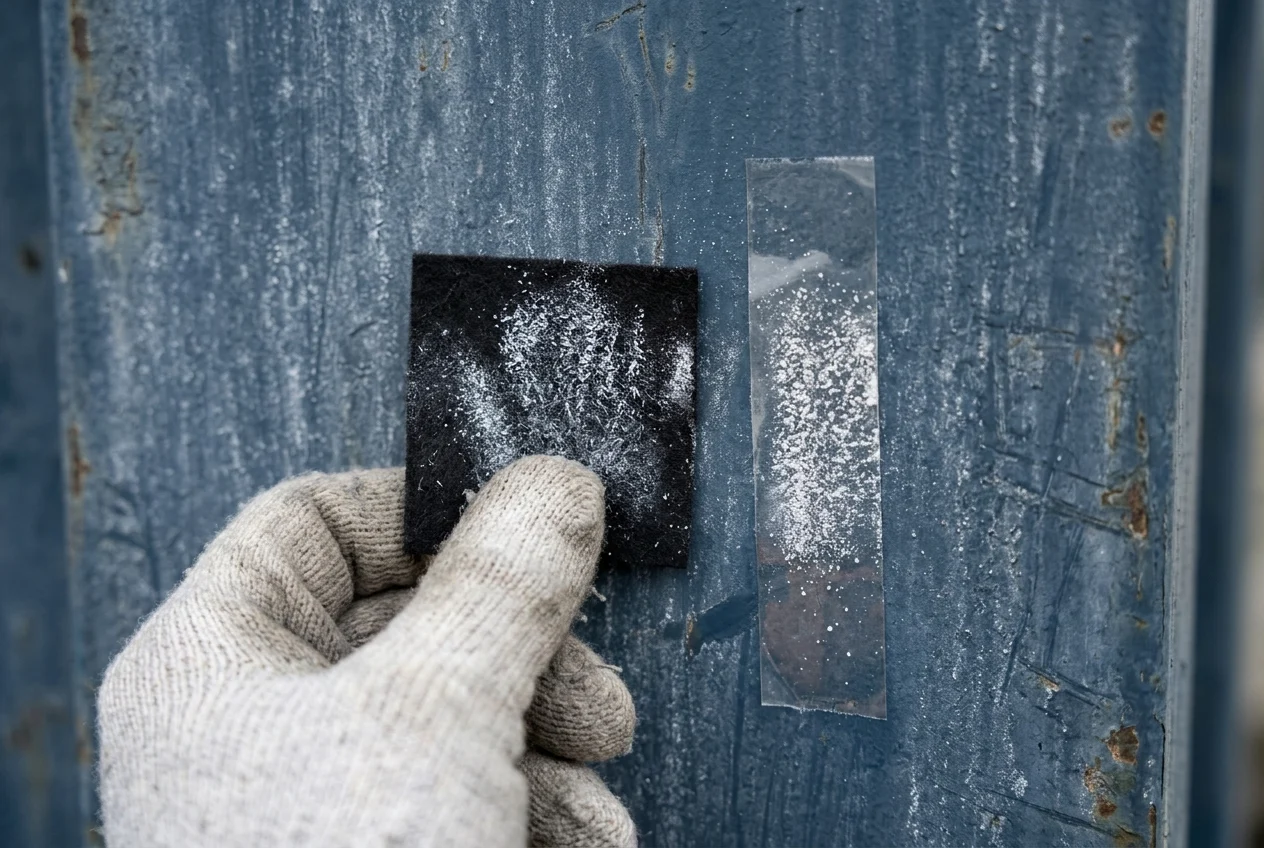
ASTM D4214 (Standard Test Methods for Evaluating Degree of Chalking of Exterior Paint Films) includes Method A (Felt Cloth Rub Method) and Method B (Adhesive Tape Method). Both felt cloth and adhesive tape methods produce a numerical chalking rating from 10 (no chalking) to 0 (heavy chalking) using ASTM photographic reference standards.
Shop-applied fluoropolymer coating applicator warranties define color fading deterioration as fading in excess of 5 Delta E Hunter units per ASTM D 2244. Shop-applied fluoropolymer coating applicator warranties define chalking deterioration as chalking in excess of a No. 8 rating when tested per Method D 4214. Shop-applied fluoropolymer coating applicator warranties define substrate corrosion deterioration as exceeding a No. 6 on cut edges and a No. 9 on field surfaces when measured per ASTM D1654.
South Florida weathering color retention specifications require 10-yr fade = 5 Delta E max for AAMA 2605, 5-yr fade = 5 Delta E max for AAMA 2604, and 1-yr slight fade for AAMA 2603. South Florida chalk resistance specifications require 10-yr chalk = 6 or better for whites and 8 or better for colors for AAMA 2605, versus 5-yr chalk = 8 or better for whites and colors for AAMA 2604, and 1-yr slight chalk for AAMA 2603. South Florida gloss and erosion resistance specifications require 10-yr = 50% retention min and 10-yr = 10% erosion loss max for AAMA 2605, versus 5-yr = 30% retention min and 5-yr = 10% erosion loss max for AAMA 2604. In Bonnell Aluminum’s AAMA specifications table, accelerated testing lists 2,000 hrs passed for cyclic corrosion, 4,000 hrs, 3,000 hrs, and 1,500 hrs passed for salt spray, and 3,000 hrs and 1,500 hrs passed for humidity. Under AAMA specification footnotes, color retention is measured using ASTM D 2244 Section 6.3 comparing an unexposed retain panel to the exposed panel after removal of dirt and chalk, and chalk is measured using the ASTM D 4214 Method D-659 procedure.
Published weathering, chalking, gloss retention, and corrosion thresholds across architectural paint specifications.
| Evaluation criterion | Published weathering or warranty threshold |
|---|---|
| Applicator warranty color fade limit | Shop-applied fluoropolymer coating applicator warranties define color fading deterioration as fading in excess of 5 Delta E Hunter units per ASTM D 2244. |
| Applicator warranty chalking limit | Shop-applied fluoropolymer coating applicator warranties define chalking deterioration as chalking in excess of a No. 8 rating when tested per Method D 4214. |
| Applicator warranty corrosion limit | Shop-applied fluoropolymer coating applicator warranties define substrate corrosion deterioration as exceeding a No. 6 on cut edges and a No. 9 on field surfaces when measured per ASTM D1654. |
| South Florida color retention tiers | South Florida weathering color retention specifications require 10-yr fade = 5 Delta E max for AAMA 2605, 5-yr fade = 5 Delta E max for AAMA 2604, and 1-yr slight fade for AAMA 2603. |
| South Florida chalk resistance tiers | South Florida chalk resistance specifications require 10-yr chalk = 6 or better for whites and 8 or better for colors for AAMA 2605, versus 5-yr chalk = 8 or better for whites and colors for AAMA 2604, and 1-yr slight chalk for AAMA 2603. |
| South Florida gloss and erosion tiers | South Florida gloss and erosion resistance specifications require 10-yr = 50% retention min and 10-yr = 10% erosion loss max for AAMA 2605, versus 5-yr = 30% retention min and 5-yr = 10% erosion loss max for AAMA 2604. |
| Accelerated corrosion and humidity hours | In Bonnell Aluminum’s AAMA specifications table, accelerated testing lists 2,000 hrs passed for cyclic corrosion, 4,000 hrs, 3,000 hrs, and 1,500 hrs passed for salt spray, and 3,000 hrs and 1,500 hrs passed for humidity. |
Before evaluating surface fade or scheduling exterior facade upkeep, consult cleaning metal wall panels, metal cladding corrosion, and the metal wall panel maintenance checklist.
Field touch-up paint limits and scratch repair execution
Metal Construction Association (MCA) Application Guidelines for Field-Applied Touch-up Paint Systems on Metal Panels serve as a guide for field-applied air-dry paint systems used in small areas. Factory-painted steel panels achieve their built-in color and gloss retention through the oven-baked process, so air-dried paints will fade and chalk much faster than oven-baked finishes. Linetec guidelines state that touch-up paint does not have the same adhesion or durability as factory-applied coatings and will exhibit chalking and fading characteristics at a noticeably faster rate than a baked-on PVDF resin-based fluoropolymer finish. Superficial scratches not too obvious from a distance of 6-9 feet will likely be obscured by normal soiling and weathering, and excessive touch-up painting creates an undesirable blotchy appearance.
Aerosol or spray applications are not recommended for blemish or scratch repairs on metal panels; the best tool is a paint pen or good quality, 1/4-in. artist brush where only the narrow edge contacts the scratch. Edges of deep scratches should be lightly sanded or feathered with #400 grit sandpaper, raw exposed steel should be treated with a zinc-rich or similar primer, and areas should be wiped with mineral spirits before touch-up is applied.
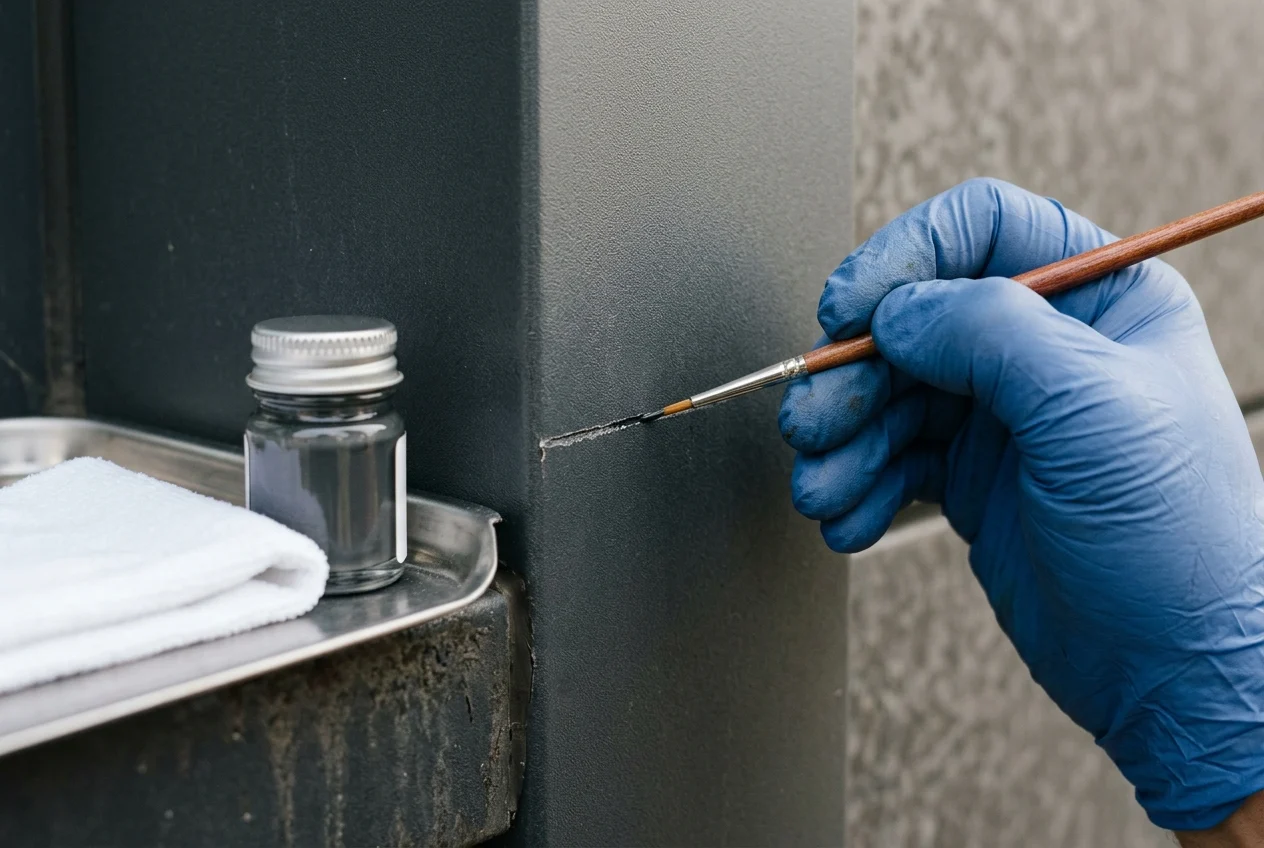
Aerosol or spray applications are not recommended for blemish or scratch repairs on metal panels; the best tool is a paint pen or good quality, 1/4-in. artist brush where only the narrow edge contacts the scratch.
Linetec states that Fluoropolymer ADS (Air-Dry System) coatings are used for repairing, restoring, or repainting the metal on buildings that have a factory applied PVDF resin-based coating and for painting materials that will not tolerate the elevated bake temperatures required by spray PVDF coatings. PPG Duranar ADS coatings are a one-component, solvent-based, air-dry fluoropolymer finish for touch-up and repair of factory-applied coil and extrusion finishes. PPG Duranar ADS FAQ states that rolling or brushing does not provide a smooth film due to the drying speed of the product; small touch-up uses an artist’s brush or dauber pen, while larger repair areas use conventional air spray. PPG Duranar ADS FAQ states that a primer is not required for basic touch-up, but a primer is required on bare metal surfaces and with some repair scenarios to obtain adequate adhesion. PPG Duranar ADS dries to touch in 1 hour, to handle in 4 hours, and reaches full cure in 24 hours under normal ambient conditions, and carries no warranty.
Valspar Fluropon Air Dry Touch-Up incorporates air-dry additive (920x346) and is tack-free in 30-45 minutes at 70°F and dry to handle after 24 hours. Valspar Fluropon Air Dry Touch-Up is designed for small damaged areas such as scratches and nicks; it is not warranted nor intended for restoration use. Valspar PVDF Air-Dry Touchup must be applied only if ambient or surface temperatures are above 50°F and allowed at least 15 minutes to dry. Valspar PVDF Air-Dry Touchup Bulletin warns that mica/metallic touchup is much more sensitive to color and appearance differences versus the factory-applied coating color.
Bonding primers and field restoration coating systems
PPG Coraflon ADS Epoxy Bonding Primer is recommended as an intermediate coat or tie coat over previously applied PVDF coatings with volume solids of 73.8% ± 3.0%. PPG Coraflon ADS Epoxy PVDF Bonding Primer achieves 5A cross-hatch adhesion per ASTM D3359, 160 forward / 80 reverse impact resistance per ASTM D2794, and F pencil hardness per ASTM D3363. Surface preparation for PPG Coraflon ADS510 Epoxy PVDF Bonding Primer requires solvent cleaning per SSPC-SP 1, abrading the substrate to remove gloss and obtain a minimum surface profile of 1.0 mil, and solvent wiping to remove dust. PPG Coraflon ADS510 Series Primer is mixed at a 1:1 volume ratio (ADS510 or 511 : ADS512) under mechanical agitation until uniform. PPG Coraflon ADS510 Series Primer dries to touch in 3 hours and to handle and recoat in 6 hours at 77°F (25°C) and 50% relative humidity.
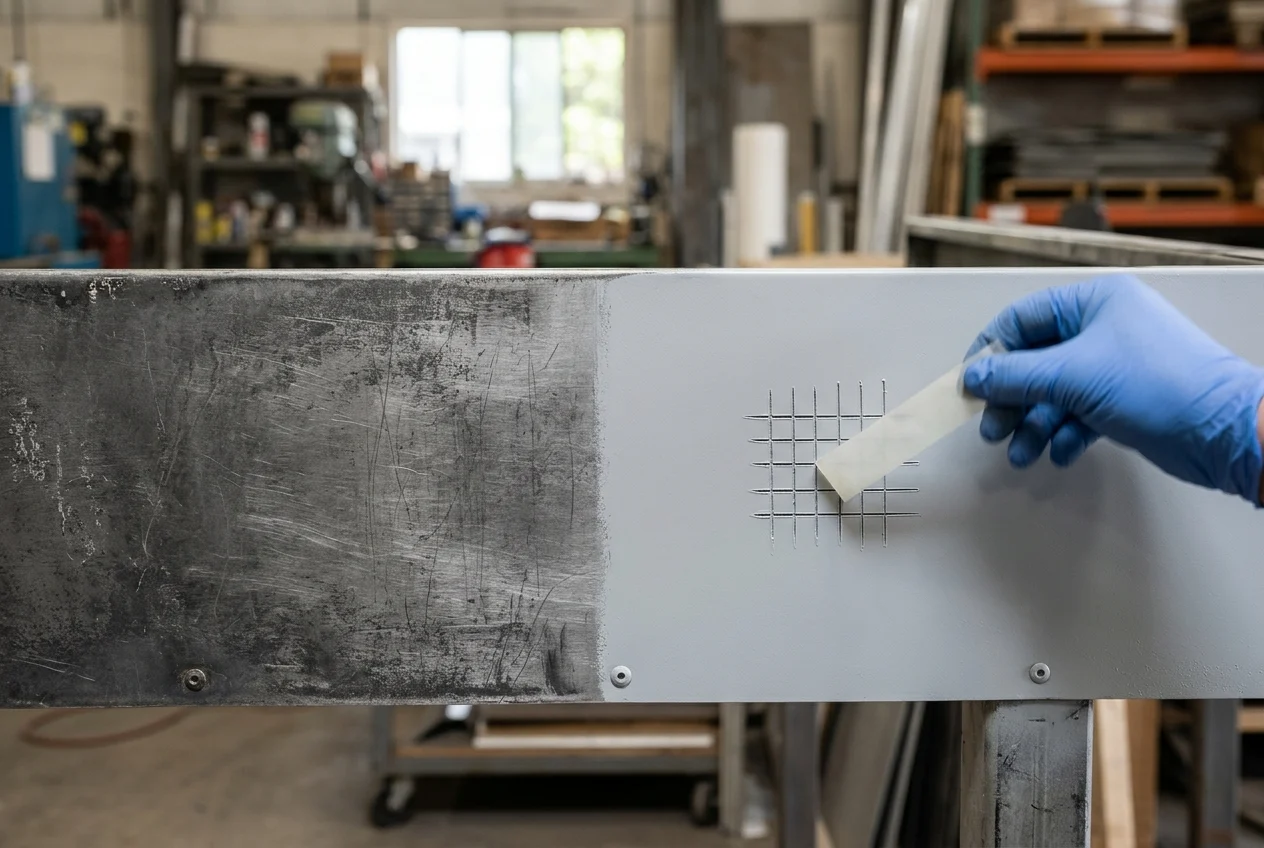
Surface preparation for PPG Coraflon ADS510 Epoxy PVDF Bonding Primer requires solvent cleaning per SSPC-SP 1, abrading the substrate to remove gloss and obtain a minimum surface profile of 1.0 mil, and solvent wiping to remove dust. PPG Coraflon ADS Epoxy PVDF Bonding Primer achieves 5A cross-hatch adhesion per ASTM D3359, 160 forward / 80 reverse impact resistance per ASTM D2794, and F pencil hardness per ASTM D3363.
Arkema’s Kynar Aquatec product line includes Kynar Aquatec ARC (70:30 PVDF:acrylic ratio), Kynar Aquatec FMA-12 (50:50 PVDF:acrylic ratio), and Kynar Aquatec CRX (70:30 two-component crosslinkable). After seven years of South Florida 45-degree south exposure, a 100 percent premium acrylic-based coating eroded so the metal substrate was completely showing through, while the Kynar Aquatec based coating remained intact. APV offers NeverFade with a 15-year product-and-labor guarantee: if the coating fades by a Delta E of five or higher, the company will replace the product and cover the labor cost of re-coating. Garland R-Mer Coat PVDF Primer dries to the touch in 30-60 minutes at 77°F (25°C) and 50% humidity, and requires waiting 24 hours for full cure before applying the topcoat.
Sherwin-Williams Bond-Plex Waterbased Acrylic Coating is formulated for use over properly prepared pre-finished siding including Fluorocarbons (Kynar), Polyester Polymers, and Silicone Polyesters. Sherwin-Williams Bond-Plex Waterbased Acrylic (Extra White B71W00211) is applied at a recommended wet film thickness of 5.0-10.0 wet mils per coat. Sherwin-Williams Bond-Plex Waterbased Acrylic achieves 1477 p.s.i. pull-off adhesion when tested per ASTM D4541. When cleaning pre-finished siding per SSPC-SP1 prior to applying Sherwin-Williams Bond-Plex, applicators must use only an emulsifying industrial detergent followed by a water rinse, and must not use hydrocarbon solvents.
Published field touch-up, bonding primer, and architectural restoration coating parameters by product system.
| Product or coating system | Published preparation, mix, film build, adhesion, or cure specification |
|---|---|
| PPG Duranar ADS touch-up | PPG Duranar ADS dries to touch in 1 hour, to handle in 4 hours, and reaches full cure in 24 hours under normal ambient conditions, and carries no warranty. |
| Valspar Fluropon Air Dry Touch-Up | Valspar Fluropon Air Dry Touch-Up incorporates air-dry additive (920x346) and is tack-free in 30-45 minutes at 70°F and dry to handle after 24 hours. |
| PPG Coraflon epoxy bonding primer prep | Surface preparation for PPG Coraflon ADS510 Epoxy PVDF Bonding Primer requires solvent cleaning per SSPC-SP 1, abrading the substrate to remove gloss and obtain a minimum surface profile of 1.0 mil, and solvent wiping to remove dust. |
| PPG Coraflon epoxy primer mix and recoat | PPG Coraflon ADS510 Series Primer is mixed at a 1:1 volume ratio (ADS510 or 511 : ADS512) under mechanical agitation until uniform. PPG Coraflon ADS510 Series Primer dries to touch in 3 hours and to handle and recoat in 6 hours at 77°F (25°C) and 50% relative humidity. |
| Garland R-Mer Coat PVDF Primer | Garland R-Mer Coat PVDF Primer dries to the touch in 30-60 minutes at 77°F (25°C) and 50% humidity, and requires waiting 24 hours for full cure before applying the topcoat. |
| Arkema Kynar Aquatec emulsions | Arkema’s Kynar Aquatec product line includes Kynar Aquatec ARC (70:30 PVDF:acrylic ratio), Kynar Aquatec FMA-12 (50:50 PVDF:acrylic ratio), and Kynar Aquatec CRX (70:30 two-component crosslinkable). |
| APV NeverFade restoration system | APV offers NeverFade with a 15-year product-and-labor guarantee: if the coating fades by a Delta E of five or higher, the company will replace the product and cover the labor cost of re-coating. |
| Sherwin-Williams Bond-Plex Waterbased Acrylic | Sherwin-Williams Bond-Plex Waterbased Acrylic (Extra White B71W00211) is applied at a recommended wet film thickness of 5.0-10.0 wet mils per coat. Sherwin-Williams Bond-Plex Waterbased Acrylic achieves 1477 p.s.i. pull-off adhesion when tested per ASTM D4541. |
When planning a full wall recoat or sorting panel replacement options across non-fluoropolymer substrates, review repainting metal siding along with our systems hub and comparisons hub.
Frequently asked questions
How do architectural fluoropolymer coating warranties define chalking and color fading deterioration?
Shop-applied fluoropolymer coating applicator warranties define color fading deterioration as fading in excess of 5 Delta E Hunter units per ASTM D 2244. Shop-applied fluoropolymer coating applicator warranties define chalking deterioration as chalking in excess of a No. 8 rating when tested per Method D 4214. Shop-applied fluoropolymer coating applicator warranties define substrate corrosion deterioration as exceeding a No. 6 on cut edges and a No. 9 on field surfaces when measured per ASTM D1654. Under AAMA specification footnotes, color retention is measured using ASTM D 2244 Section 6.3 comparing an unexposed retain panel to the exposed panel after removal of dirt and chalk, and chalk is measured using the ASTM D 4214 Method D-659 procedure.
How is paint film chalking evaluated in the field and in accelerated weathering tests?
ASTM D4214 (Standard Test Methods for Evaluating Degree of Chalking of Exterior Paint Films) includes Method A (Felt Cloth Rub Method) and Method B (Adhesive Tape Method). Both felt cloth and adhesive tape methods produce a numerical chalking rating from 10 (no chalking) to 0 (heavy chalking) using ASTM photographic reference standards. Chalking rate is influenced by pigment volume concentration (PVC), binder chemistry, and TiO2 pigment grade: anatase TiO2 catalyzes photodegradation of the binder more aggressively than rutile TiO2. Laboratory accelerated weathering for chalking resistance comparison is conducted using xenon arc (ASTM G155) or UV fluorescent (ASTM G154) apparatus.
When should superficial scratches on factory-painted metal panels be left untouched?
Factory-painted steel panels achieve their built-in color and gloss retention through the oven-baked process, so air-dried paints will fade and chalk much faster than oven-baked finishes. Superficial scratches not too obvious from a distance of 6-9 feet will likely be obscured by normal soiling and weathering, and excessive touch-up painting creates an undesirable blotchy appearance. Aerosol or spray applications are not recommended for blemish or scratch repairs on metal panels; the best tool is a paint pen or good quality, 1/4-in. artist brush where only the narrow edge contacts the scratch. Edges of deep scratches should be lightly sanded or feathered with #400 grit sandpaper, raw exposed steel should be treated with a zinc-rich or similar primer, and areas should be wiped with mineral spirits before touch-up is applied.
How is an existing fluoropolymer coating prepared for an epoxy bonding tie-coat primer?
PPG Coraflon ADS Epoxy Bonding Primer is recommended as an intermediate coat or tie coat over previously applied PVDF coatings with volume solids of 73.8% ± 3.0%. Surface preparation for PPG Coraflon ADS510 Epoxy PVDF Bonding Primer requires solvent cleaning per SSPC-SP 1, abrading the substrate to remove gloss and obtain a minimum surface profile of 1.0 mil, and solvent wiping to remove dust. PPG Coraflon ADS510 Series Primer is mixed at a 1:1 volume ratio (ADS510 or 511 : ADS512) under mechanical agitation until uniform. PPG Coraflon ADS510 Series Primer dries to touch in 3 hours and to handle and recoat in 6 hours at 77°F (25°C) and 50% relative humidity.
What waterborne coating systems are used for field restoration of weathered fluoropolymer metal panels?
Arkema's Kynar Aquatec product line includes Kynar Aquatec ARC (70:30 PVDF:acrylic ratio), Kynar Aquatec FMA-12 (50:50 PVDF:acrylic ratio), and Kynar Aquatec CRX (70:30 two-component crosslinkable). After seven years of South Florida 45-degree south exposure, a 100 percent premium acrylic-based coating eroded so the metal substrate was completely showing through, while the Kynar Aquatec based coating remained intact. APV offers NeverFade with a 15-year product-and-labor guarantee: if the coating fades by a Delta E of five or higher, the company will replace the product and cover the labor cost of re-coating. Garland R-Mer Coat PVDF Primer dries to the touch in 30-60 minutes at 77°F (25°C) and 50% humidity, and requires waiting 24 hours for full cure before applying the topcoat.
Sources
- Repainting Metal Siding: Name the Metal and Finish Before You Repaint — Metal Coverings
- Shop-Applied Fluoropolymer Coatings for Metal Guide Specification — Arkema
- High Performance Water-Based Field-Applied Organic Finishes for Architectural Restoration — Arkema and APV Engineered Coatings
- Coil Coatings Product Comparison Guide — Sherwin-Williams Coil Coatings
- Fluropon Air Dry Touch-Up Data Sheet — Valspar
- PVDF Air-Dry Touchup Bulletin — Valspar
- Bond-Plex Waterbased Acrylic Coating Product Data Sheet — Sherwin-Williams
- Coraflon ADS Epoxy PVDF Bonding Primer Technical Data Bulletin — PPG
- Duranar ADS Air Dry Fluoropolymer Coatings Frequently Asked Questions — PPG
- Technical Bulletin: Touch-Up Paint — AEP Span
- Application Guidelines for Field-Applied Touch-up Paint Systems on Metal Panels — Metal Construction Association
- Test Procedures for Measuring Exterior Paint Film Chalking — Infinita Lab
- Paint AAMA Specifications — Bonnell Aluminum
- Paint Touch-Up and PVDF Resin-Based Air-Dry Systems Guidelines — Linetec
- R-Mer Coat PVDF Primer Technical Data Sheet — The Garland Company