Direct answer
In broad-band sound-absorptive treatments, perforated metal sheet acts as a sound-transparent protective covering without altering the intrinsic performance of the absorptive material. Armstrong MetalWorks Linear Classics Wall Panels have a factory-applied powder coated metal finish, achieve a 0.70 NRC rating in D-20 mounting, and carry a Class A fire performance rating. Freudenberg SoundTex is an acoustic nonwoven with a thickness of approximately 0.27 mm applied behind perforated elements made of steel, aluminium, wood, or plasterboard to absorb sound and save on freight, storage, and installation costs.
Key takeaways
- In broad-band sound-absorptive treatments, perforated metal sheet acts as a sound-transparent protective covering without altering the intrinsic performance of the absorptive material.
- Armstrong MetalWorks Linear Classics Wall Panels have a factory-applied powder coated metal finish, achieve a 0.70 NRC rating in D-20 mounting, and carry a Class A fire performance rating.
- Freudenberg SoundTex is an acoustic nonwoven with a thickness of approximately 0.27 mm applied behind perforated elements made of steel, aluminium, wood, or plasterboard to absorb sound and save on freight, storage, and installation costs.
- Rigidized Metals states that a Z-clip attachment is ideal for acoustical wall panels because it retains acoustic transparency and does not compromise acoustic performance.
- Sound absorption testing conducted in accordance with ISO 354 requires a larger 10 m2 (107.6 ft2) test specimen.
Selecting acoustic wall panels commercial assemblies requires coordinating the perforated metal facing, the rear acoustic nonwoven fleece or porous insulation board, and the wall mounting cavity. In broad-band sound-absorptive treatments, perforated metal sheet acts as a sound-transparent protective covering without altering the intrinsic performance of the absorptive material. The Whole Building Design Guide recommends reducing workplace sound reverberation time by specifying sound absorbing materials, specifying acoustical ceilings or ceiling tiles with an NRC of 0.75, and designing high STC walls to limit noise transmission.
For broader architectural metal wall formats, review the metal wall panel systems hub and our commercial systems overview alongside the metal wall coverings guide. Where exterior wind-load spans and solar shading govern the facade rather than interior reverberation control, use the perforated metal facade panels guide and the general perforated metal panels overview.
Types of acoustic wall panels for commercial interiors
Comparing types of acoustic wall panels across mineral fiber, fiberglass, linear microperforated metal planks, circular and slotted metal pans, micro-perforated corrugated aluminum, and deep-textured stainless steel clarifies how each assembly balances surface durability and sound absorption. Armstrong states that fiberglass and mineral fiber acoustical wall panels provide sound absorption for noise control in commercial interior applications and install over smooth, structurally sound interior wall surfaces. Armstrong commercial acoustical wall panels absorb sound energy to reduce echo, reverberation, background noise, and sound reflections between hard surfaces, with many panels achieving NRC ratings from 0.70 up to 0.90+. Armstrong lists typical commercial acoustical wall panel performance ranges of NRC 0.70 to 0.90+ for sound absorption within a room and STC up to approximately 43-53 (depending on system) for sound blocking between spaces.
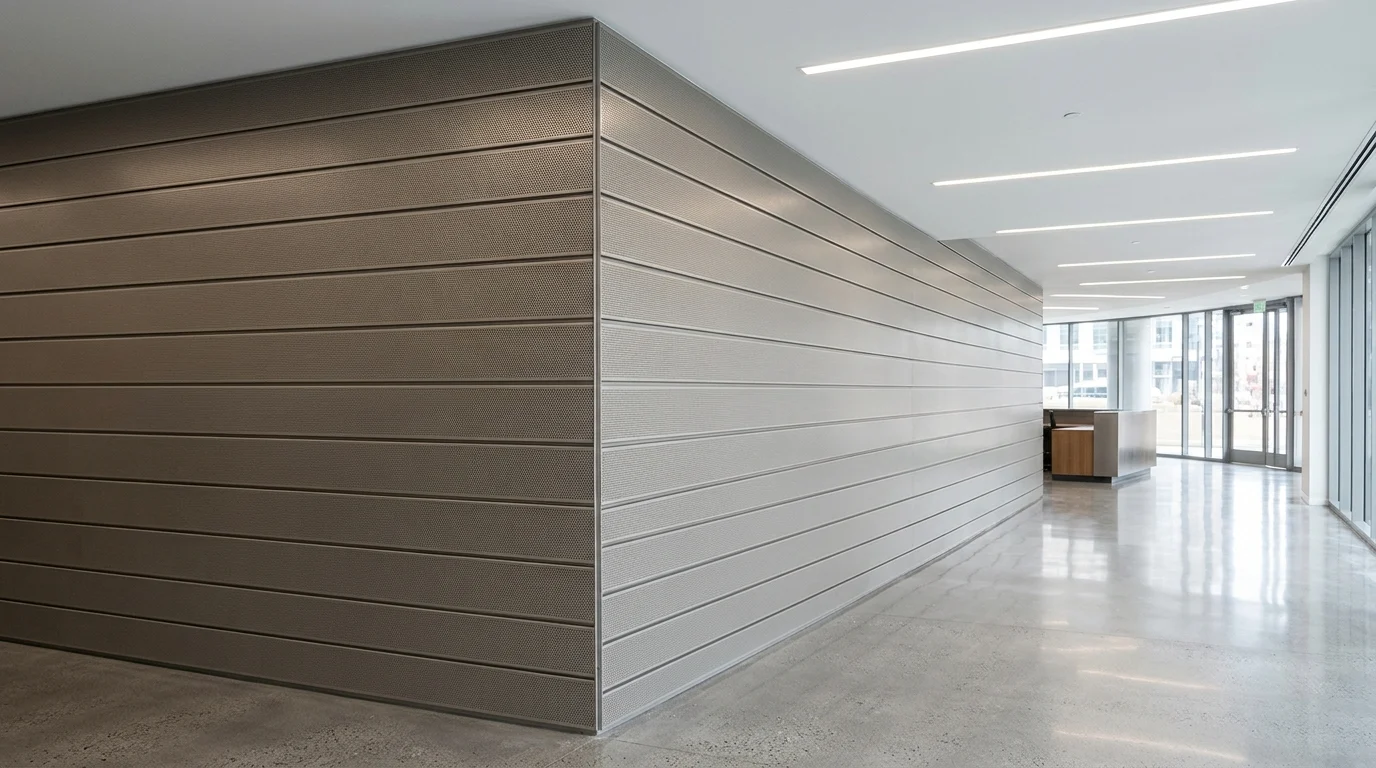
When high-traffic commercial corridors, transit lobbies, or public spaces require a cleanable metal face, specifiers select among several perforated metal wall systems. Armstrong MetalWorks Linear Classics Wall Panels are offered in nominal 2”, 4”, 6”, 8”, 10”, and 12” wide panels (including a nominal 1” reveal), install horizontally on walls or in 90º angled or curved ceiling-to-wall transitions, and provide acoustical options with microperforated panels. Armstrong MetalWorks Linear Classics Wall Panels have a factory-applied powder coated metal finish, achieve a 0.70 NRC rating in D-20 mounting, and carry a Class A fire performance rating. Armstrong MetalWorks Linear Classics Wall Panels are evaluated for surface impact resistance per a modified ASTM D1037 striking ball impact test, washability per ATSM D4828, and scrubbability up to 150 scrub cycles per ATSM 02486.
Published commercial acoustic wall panel families and manufacturer specifications.
| Panel family | Geometry and construction | Published acoustic and fire data |
|---|---|---|
| Mineral fiber and fiberglass | Armstrong states that fiberglass and mineral fiber acoustical wall panels provide sound absorption for noise control in commercial interior applications and install over smooth, structurally sound interior wall surfaces. | Armstrong lists typical commercial acoustical wall panel performance ranges of NRC 0.70 to 0.90+ for sound absorption within a room and STC up to approximately 43-53 (depending on system) for sound blocking between spaces. |
| Linear microperforated planks | Armstrong MetalWorks Linear Classics Wall Panel item 8121 is a 2” x 96” plank with 5/8” thickness, a square edge with extended flange, M2 MicroPerforated pattern at 18.4% open area, Class A fire performance, and 61% light reflectance. | Armstrong MetalWorks Linear Classics Wall Panels have a factory-applied powder coated metal finish, achieve a 0.70 NRC rating in D-20 mounting, and carry a Class A fire performance rating. |
| USG perforated metal panels | USG identifies metal perforations with a coding system consisting of four components: Perforation Shape (Circle, Square, Obround, Rectangle), Perforation Pattern (Straight 90 degree, Diagonal 45 degree, Equilateral 60 degree), Perforation Hole Size (.XXX”), and Perforation Open Area (.XX%). | USG Note 1 and Note 7 state that open area percentage does not have a direct correlation to NRC value, that listed NRC values are for perforated panels with an Acoustibond backer tested per ASTM C423 in type E400 mounting (as described in ASTM E795), and that higher NRC values may be achieved with additional acoustical infill. |
| Textured stainless steel | Rigidized Metals TXTRsound interior acoustical metal wall and ceiling panel faces are fabricated from 20 gauge (.036”) 304 stainless steel (2B Finish or #4 Finish, with powder coatings available) perforated with .066” diameter round holes on .109” spacing in a 60 stagger for 33.09% open area. | Tested per ASTM method C 423-09a in an ASTM E 795-05 Type A mounting (laid directly on the floor), Rigidized Metals perforated stainless steel pattern 6WL achieves 0.50 NRC (0.51 SAA) with a 1/2” acoustical mat and 0.75 NRC (0.73 SAA) with a 1” acoustical mat, while pattern 1RL achieves 0.55 NRC (0.52 SAA) with a 1/2” acoustical mat and 0.75 NRC (0.77 SAA) with a 1” acoustical mat. |
For non-acoustic decorative interior wall metal selections, see the interior metal wall panels guide. For alloy surface properties in public corridors, compare stainless steel wall panels.
How perforation coding and open area affect NRC
Perforation geometry governs how sound waves pass through the metal skin into the backing assembly. USG identifies metal perforations with a coding system consisting of four components: Perforation Shape (Circle, Square, Obround, Rectangle), Perforation Pattern (Straight 90 degree, Diagonal 45 degree, Equilateral 60 degree), Perforation Hole Size (.XXX”), and Perforation Open Area (.XX%). USG Note 1 and Note 7 state that open area percentage does not have a direct correlation to NRC value, that listed NRC values are for perforated panels with an Acoustibond backer tested per ASTM C423 in type E400 mounting (as described in ASTM E795), and that higher NRC values may be achieved with additional acoustical infill.
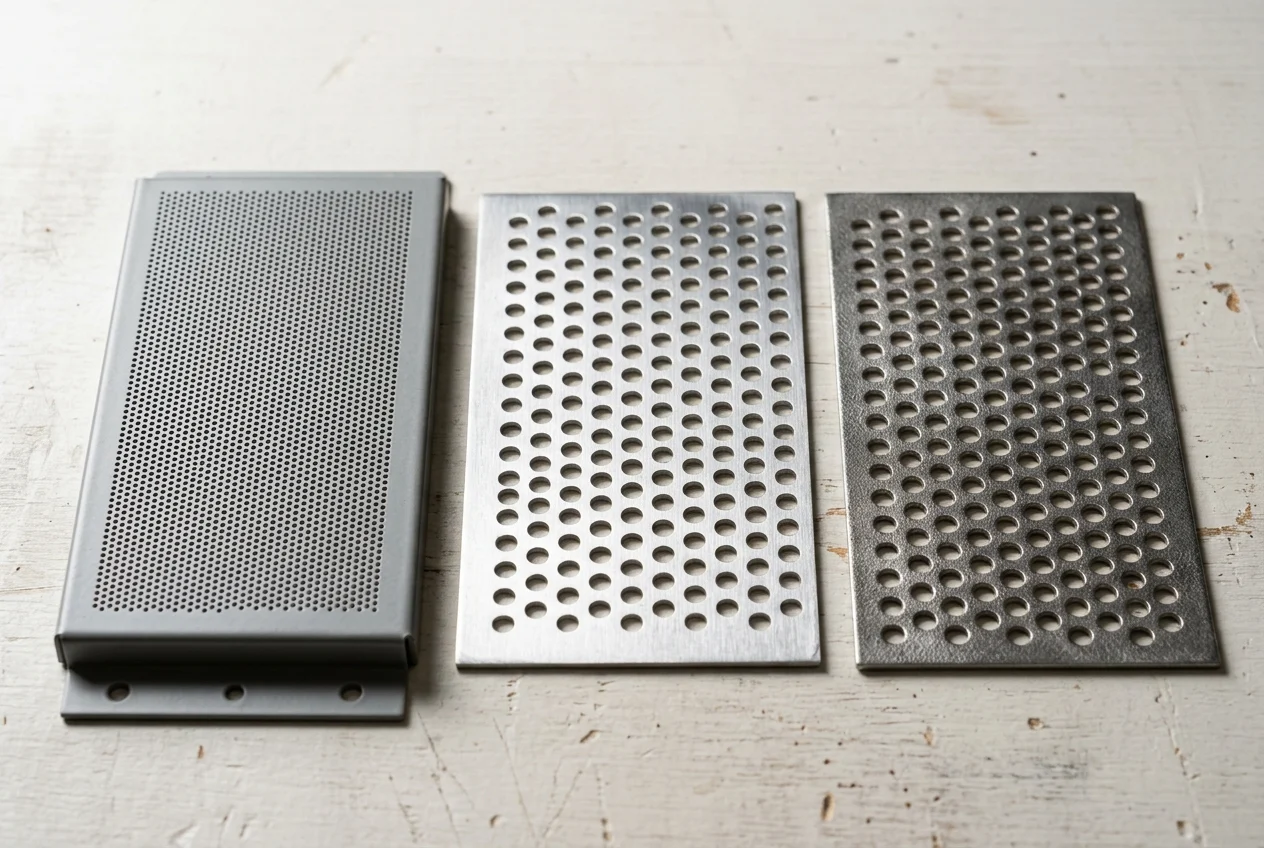
USG identifies metal perforations with a coding system consisting of four components: Perforation Shape (Circle, Square, Obround, Rectangle), Perforation Pattern (Straight 90 degree, Diagonal 45 degree, Equilateral 60 degree), Perforation Hole Size (.XXX”), and Perforation Open Area (.XX%).
Across circular, obround, and rectangular patterns, published laboratory data demonstrates how hole diameter and pattern arrangement interact with open area. In USG’s circular perforation table, pattern CS03002 (Circle, 90 degrees, .030” hole, 2% open area) achieves 0.50 NRC, pattern CD04004 (Circle, 45 degrees, .040” hole, 4.4% open area) achieves 0.60 NRC, and pattern CD05006 (Circle, 45 degrees, .050” hole, 6.3% open area) achieves 0.70 NRC. In USG’s circular perforation table, pattern CD06305 (Circle, 45 degrees, .0625” hole, 5% open area) achieves 0.65 NRC, pattern CD06310 (Circle, 45 degrees, .0625” hole, 10% open area) achieves 0.70 NRC, and pattern CE07814 (Circle, 60 degrees, .078” hole, 14% open area) achieves 0.75 NRC.
At higher open area percentages, hole diameter and hole shape continue to influence the measured coefficient. In USG’s circular perforation table, pattern CE18820 (Circle, 60 degrees, .188” hole, 20% open area) achieves 0.80 NRC and pattern CS25020 (Circle, 90 degrees, .250” hole, 20% open area) achieves 0.75 NRC. In USG’s non-circular perforation tables, obround pattern OS12523 (90 degrees, .125” hole, 23% open area) achieves 0.80 NRC and rectangular pattern RS12527 (90 degrees, .125” hole, 27% open area) achieves 0.75 NRC.
In linear plank and deep-textured stainless steel assemblies, manufacturer specifications pair defined hole patterns with specific panel profiles. Armstrong MetalWorks Linear Classics Wall Panel item 8121 is a 2” x 96” plank with 5/8” thickness, a square edge with extended flange, M2 MicroPerforated pattern at 18.4% open area, Class A fire performance, and 61% light reflectance. Armstrong MetalWorks Linear Classics Wall Panel plank with dimensions 2” x 96” x 5/8” weighs 1.61 lbs/SF and is packaged at 32 Sq Ft (24 pieces) per carton. Rigidized Metals TXTRsound interior acoustical metal wall and ceiling panel faces are fabricated from 20 gauge (.036”) 304 stainless steel (2B Finish or #4 Finish, with powder coatings available) perforated with .066” diameter round holes on .109” spacing in a 60 stagger for 33.09% open area.
Acoustic fleece, mineral wool, fiberglass, and cellulose backings
Behind the perforated metal skin, SOUNDTEX provides an increased resistance to airflow which dissipates sound energy by converting it into heat. In the IPA Acoustics Handbook comparison of glass fiber materials, a layer only one inch thick is effective at high frequencies but very poor at low frequencies. In the IPA Acoustics Handbook comparison of glass fiber materials, a six inch layer absorbs about 99% of incident noise energy across all frequencies, but takes up space and is expensive.
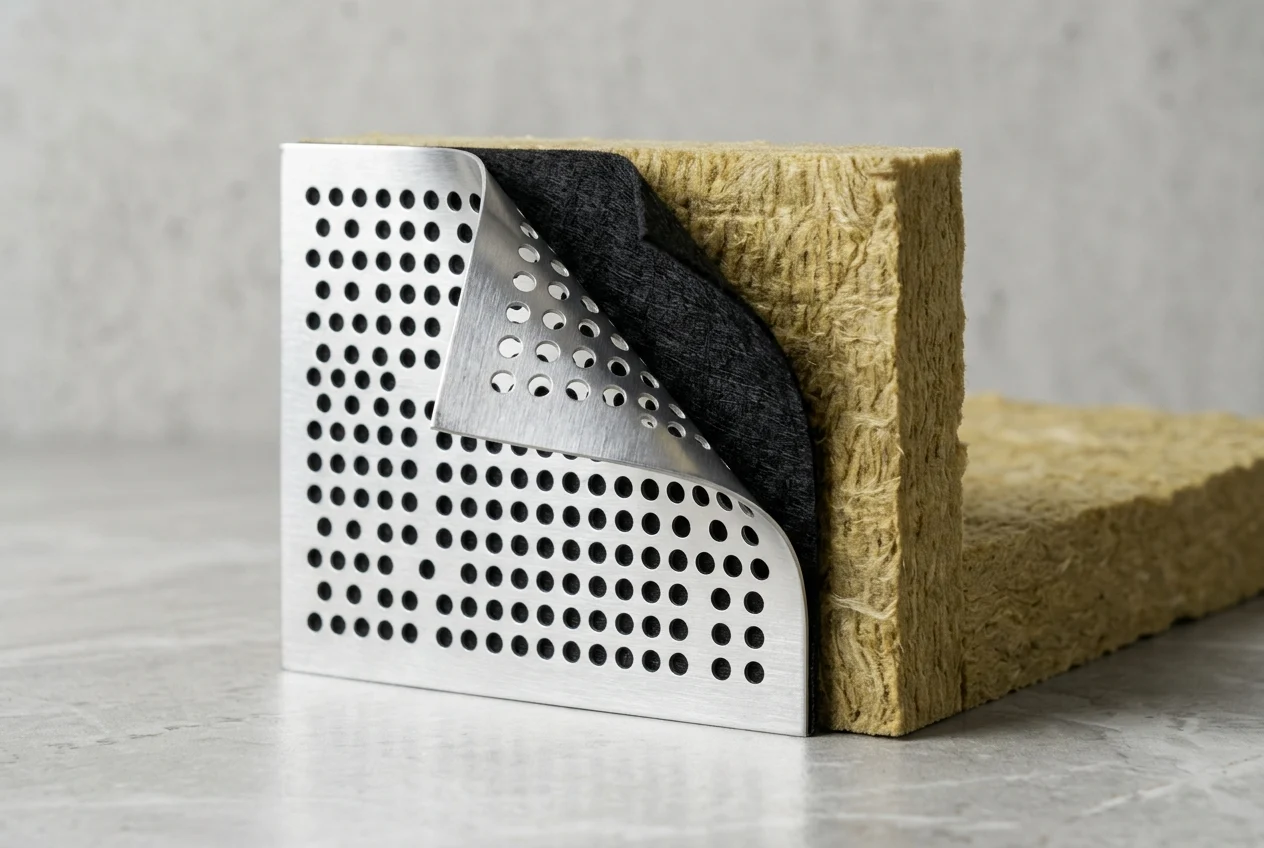
Freudenberg SoundTex is an acoustic nonwoven with a thickness of approximately 0.27 mm applied behind perforated elements made of steel, aluminium, wood, or plasterboard to absorb sound and save on freight, storage, and installation costs.
Non-woven acoustic fleece and cellulose panels
Thin SOUNDTEX non-woven 0.27 mm thick applied behind perforated metal increases resistance to airflow and suits assemblies where space constraints exist. Freudenberg SoundTex is an acoustic nonwoven with a thickness of approximately 0.27 mm applied behind perforated elements made of steel, aluminium, wood, or plasterboard to absorb sound and save on freight, storage, and installation costs. Freudenberg states that SoundTex acoustic nonwovens are lightweight, air permeable, and do not interfere with certain ventilation processes, giving architects flexibility in panel shapes, contours, and placement of air inlets and vents.
In the ATAS specification sheet, SOUNDTEX is a 0.27 mm thick (including hot melt adhesive backing), 63 g/m2 random non-woven fabric made of cellulose and glass with a sound impedance of 190 Ns/m.3 that is used where concerns about airborne glass fibers or space constraints exist. The ATAS specification sheet describes CFAB cellulose insulation sound absorption panels as Class A fire-rated panels made from 65-75% recycled content in 1/2”, 1”, or 2” thicknesses (3PCF density) and 2’ x 4’, 4’ x 4’, and 4’ x 8’ panel sizes without harmful airborne particles or skin-irritating fiber glass insulation.
Stone wool batts and rigid mineral wool boards
Stone wool cavity batts and rigid boards increase low-frequency and mid-frequency absorption as board thickness increases. Tested per ASTM C423, ROCKWOOL AFB (Acoustical Fire Batt) stone wool insulation achieves an NRC of 0.70 at 1.0” thickness (0.25 at 250 Hz, 0.65 at 500 Hz), 0.85 at 1.5” (0.44 at 250 Hz, 0.94 at 500 Hz), and 0.95 at 2.0” (0.60 at 250 Hz, 1.09 at 500 Hz). Tested per ASTM C423, ROCKWOOL AFB stone wool insulation achieves an NRC of 1.05 at 3.0” thickness (0.52 at 125 Hz, 0.96 at 250 Hz, 1.18 at 500 Hz), 1.10 at 4.0” (0.86 at 125 Hz, 1.11 at 250 Hz), and 1.15 at 6.0” (1.11 at 125 Hz, 1.28 at 250 Hz). ROCKWOOL AFB is non-combustible at 750 °C (1382 °F), achieves Flame Spread = 0 and Smoke Developed = 0 under ASTM E84 (UL 723) and CAN/ULC S102, and is rated for a UL 181 maximum air velocity of 1000 fpm (5.08 m/s).
Where rigid boards are specified behind perforated metal panels, compressive resistance varies by board density. Tested per ASTM C423, ROCKWOOL Rockboard rigid stone wool board achieves an NRC of 0.8 at 1” thickness (0.32 at 250 Hz, 0.77 at 500 Hz), 0.9 at 1.5” (0.48 at 250 Hz, 0.96 at 500 Hz), 1 at 2” (0.68 at 250 Hz, 1.12 at 500 Hz), 1.05 at 3” (0.95 at 250 Hz), and 1.1 at 4”. ROCKWOOL Rockboard 40 has an actual density of 4 lb/ft³ (64 kg/m³) and compressive strength of 90 psf (4.3 kPa) at 10% compression, while Rockboard 60 has an actual density of 6 lb/ft³ (96 kg/m³) and compressive strength of 355 psf (17 kPa) at 10% compression; both exhibit 0.03% moisture sorption under ASTM C1104 and Flame spread index = 0 / Smoke development index = 0 under ASTM E84 (UL 723). For broader wall fire considerations, see the metal wall panel fire performance guide.
Semi-rigid fiberglass boards and vapor-retarder facings
Fiberglass acoustic boards are manufactured in multiple densities and facing configurations that directly alter high-frequency sound absorption. Under ASTM C303 and ASTM C165, Owens Corning Fiberglas Type 703 semi-rigid board has a density of 3.0 pcf (48 kg/m3) and minimum compressive strength of 25 lb/ft2 (1197 Pa) at 10% deformation, whereas Type 705 rigid board has a density of 6.0 pcf (96 kg/m3) and minimum compressive strength of 200 lb/ft2 (9576 Pa) at 10% deformation. Tested per UL 723, ASTM E84, and CAN/ULC S102, Owens Corning Fiberglas Series boards have a Flame Spread Index of 5 and Smoke Developed Index of 5 when unfaced, and a Flame Spread Index of 25 and Smoke Developed Index of 50 when faced.
Tested per ASTM C423 in Type A mounting (material placed against a solid backing), Owens Corning 703 Unfaced fiberglass board achieves 0.70 NRC at 1” (25.00 mm; 0.26 at 250 Hz, 0.63 at 500 Hz), 1.00 NRC at 2” (51.00 mm; 0.71 at 250 Hz, 1.14 at 500 Hz), and 1.15 NRC at 3” (76.00 mm; 1.09 at 250 Hz) and 4” (100.00 mm; 1.26 at 250 Hz). In Owens Corning’s Type A mounting table, 705 Unfaced fiberglass board achieves 0.75 NRC at 1” (25.00 mm; 0.24 at 250 Hz, 0.73 at 500 Hz), 1.05 NRC at 2” (51.00 mm; 0.86 at 250 Hz, 1.16 at 500 Hz), and 1.10 NRC at 3” (76.00 mm) and 4” (100.00 mm). In Owens Corning’s Type A mounting table, at 2” (51.00 mm), vapor-retarder-faced boards have lower high-frequency absorption and NRC than unfaced boards: 2” (51.00 mm) 703 FRK achieves 0.75 NRC (0.51 at 2000 Hz, 0.32 at 4000 Hz), 2” 705 FRK achieves 0.60 NRC, 2” 703 ASJ Max achieves 0.65 NRC, and 2” 705 ASJ Max achieves 0.50 NRC.
Published acoustic backing materials, densities, and sound absorption specifications.
| Backing material | Density and physical properties | Published acoustic and fire data |
|---|---|---|
| ATAS SOUNDTEX fleece | In the ATAS specification sheet, SOUNDTEX is a 0.27 mm thick (including hot melt adhesive backing), 63 g/m2 random non-woven fabric made of cellulose and glass with a sound impedance of 190 Ns/m.3 that is used where concerns about airborne glass fibers or space constraints exist. | Freudenberg states that SoundTex acoustic nonwovens are lightweight, air permeable, and do not interfere with certain ventilation processes, giving architects flexibility in panel shapes, contours, and placement of air inlets and vents. |
| ROCKWOOL AFB stone wool | ROCKWOOL AFB is non-combustible at 750 °C (1382 °F), achieves Flame Spread = 0 and Smoke Developed = 0 under ASTM E84 (UL 723) and CAN/ULC S102, and is rated for a UL 181 maximum air velocity of 1000 fpm (5.08 m/s). | Tested per ASTM C423, ROCKWOOL AFB (Acoustical Fire Batt) stone wool insulation achieves an NRC of 0.70 at 1.0” thickness (0.25 at 250 Hz, 0.65 at 500 Hz), 0.85 at 1.5” (0.44 at 250 Hz, 0.94 at 500 Hz), and 0.95 at 2.0” (0.60 at 250 Hz, 1.09 at 500 Hz). |
| ROCKWOOL Rockboard | ROCKWOOL Rockboard 40 has an actual density of 4 lb/ft³ (64 kg/m³) and compressive strength of 90 psf (4.3 kPa) at 10% compression, while Rockboard 60 has an actual density of 6 lb/ft³ (96 kg/m³) and compressive strength of 355 psf (17 kPa) at 10% compression; both exhibit 0.03% moisture sorption under ASTM C1104 and Flame spread index = 0 / Smoke development index = 0 under ASTM E84 (UL 723). | Tested per ASTM C423, ROCKWOOL Rockboard rigid stone wool board achieves an NRC of 0.8 at 1” thickness (0.32 at 250 Hz, 0.77 at 500 Hz), 0.9 at 1.5” (0.48 at 250 Hz, 0.96 at 500 Hz), 1 at 2” (0.68 at 250 Hz, 1.12 at 500 Hz), 1.05 at 3” (0.95 at 250 Hz), and 1.1 at 4”. |
| Unfaced fiberglass boards | Under ASTM C303 and ASTM C165, Owens Corning Fiberglas Type 703 semi-rigid board has a density of 3.0 pcf (48 kg/m3) and minimum compressive strength of 25 lb/ft2 (1197 Pa) at 10% deformation, whereas Type 705 rigid board has a density of 6.0 pcf (96 kg/m3) and minimum compressive strength of 200 lb/ft2 (9576 Pa) at 10% deformation. | Tested per ASTM C423 in Type A mounting (material placed against a solid backing), Owens Corning 703 Unfaced fiberglass board achieves 0.70 NRC at 1” (25.00 mm; 0.26 at 250 Hz, 0.63 at 500 Hz), 1.00 NRC at 2” (51.00 mm; 0.71 at 250 Hz, 1.14 at 500 Hz), and 1.15 NRC at 3” (76.00 mm; 1.09 at 250 Hz) and 4” (100.00 mm; 1.26 at 250 Hz). |
| Faced fiberglass boards | Tested per UL 723, ASTM E84, and CAN/ULC S102, Owens Corning Fiberglas Series boards have a Flame Spread Index of 5 and Smoke Developed Index of 5 when unfaced, and a Flame Spread Index of 25 and Smoke Developed Index of 50 when faced. | In Owens Corning’s Type A mounting table, at 2” (51.00 mm), vapor-retarder-faced boards have lower high-frequency absorption and NRC than unfaced boards: 2” (51.00 mm) 703 FRK achieves 0.75 NRC (0.51 at 2000 Hz, 0.32 at 4000 Hz), 2” 705 FRK achieves 0.60 NRC, 2” 703 ASJ Max achieves 0.65 NRC, and 2” 705 ASJ Max achieves 0.50 NRC. |
Reverberation room testing and wall mounting mechanics
Comparing acoustic submittals across manufacturers requires verifying both the laboratory test procedure and the mounting configuration used during the test. Under ASTM C423 (Standard Test Method for Sound Absorption and Sound Absorption Coefficients by the Reverberation Room Method), acoustical certification is not required by building codes, but the NRC rating is required by acoustical consultants designing auditoriums, classrooms, and offices. ASTM C423 covers the measurement of the sound absorptive properties of a product in a reverberation room by measuring the decay rate of broadband noise when it is switched on and off in the room.
For products that cover an extended plane surface such as wall panels and ceiling panels, ASTM C423 recommends a sample size of 8’ wide by 9’ long, and the ASTM E795 standard practice defines the mounting technique. In the ASTM C423 test procedure, broadband noise decay time for a 25 decibel drop is measured across frequencies from 80 to 5000 hertz, averaging 10 decays at each of five microphone locations for the empty room and 50 decays with the test specimen installed. Under ASTM C423, the NRC (Noise Reduction Coefficient) rating is the average of the absorption coefficients at 250, 500, 1000, and 2000 hertz rounded to the nearest multiple of .05, while the SAA (Sound Absorption Average) rating is the average of the 1/3 octave band absorption coefficients from 200 to 2500 hertz rounded to the nearest multiple of .01. Sound absorption testing conducted in accordance with ISO 354 requires a larger 10 m2 (107.6 ft2) test specimen.
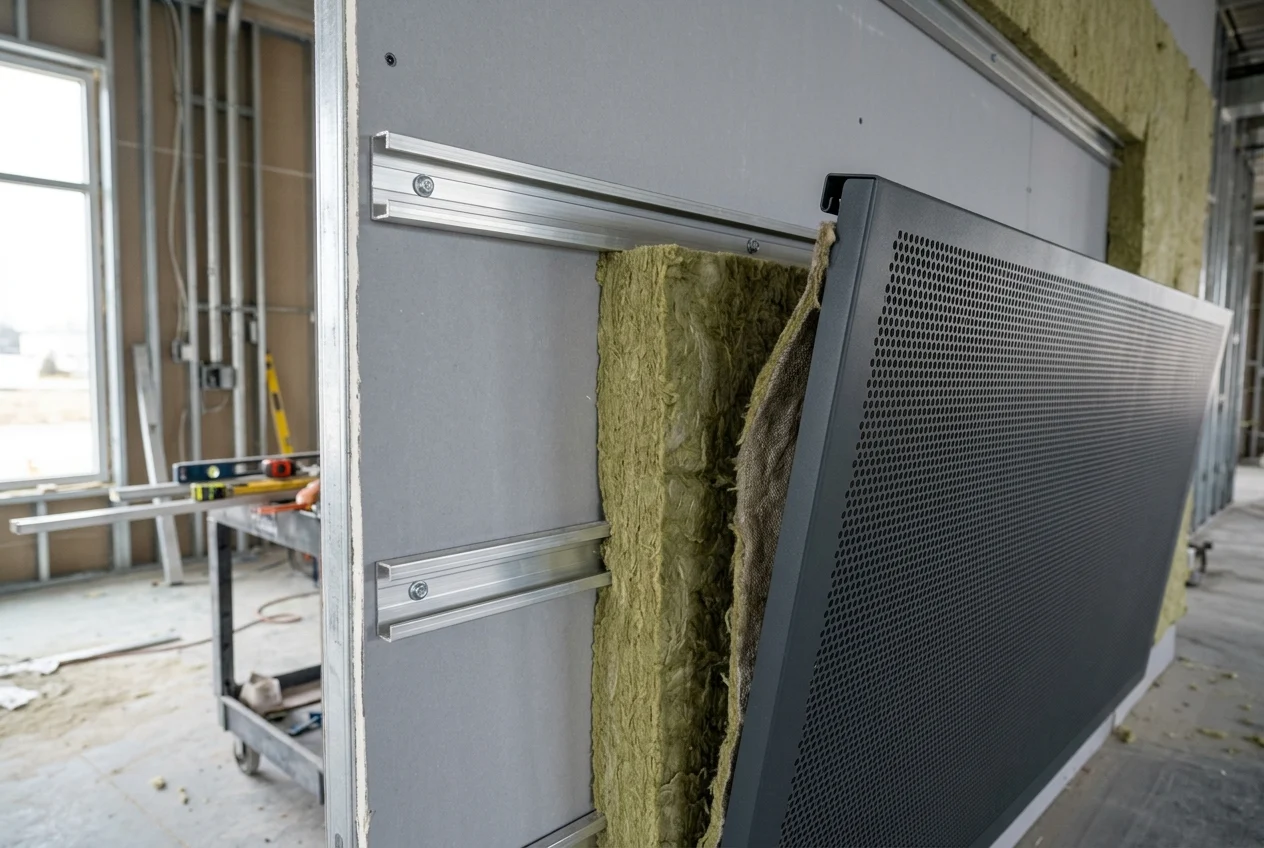
Rigidized Metals states that a Z-clip attachment is ideal for acoustical wall panels because it retains acoustic transparency and does not compromise acoustic performance.
Mounting geometry and rear airspace depth directly affect the measured results. Rigidized Metals states that a Z-clip attachment is ideal for acoustical wall panels because it retains acoustic transparency and does not compromise acoustic performance. Tested per ASTM method C 423-09a in an ASTM E 795-05 Type A mounting (laid directly on the floor), Rigidized Metals perforated stainless steel pattern 6WL achieves 0.50 NRC (0.51 SAA) with a 1/2” acoustical mat and 0.75 NRC (0.73 SAA) with a 1” acoustical mat, while pattern 1RL achieves 0.55 NRC (0.52 SAA) with a 1/2” acoustical mat and 0.75 NRC (0.77 SAA) with a 1” acoustical mat. ASI Architectural Microperf Silk Metal micro-perforated aluminum panels (also available as custom wall panels) achieve a 0.80 NRC rating per ASTM C423 with a 4” airspace and no acoustical backer needed, with octave-band absorption coefficients of 0.86 at 125Hz, 0.94 at 250Hz, 0.65 at 500Hz, 0.77 at 1KHz, 0.76 at 2KHz, and 0.75 at 4KHZ.
Commercial acoustic wall panels cost drivers and specification checklist
Evaluating acoustic wall panels cost across commercial interiors depends on the base metal alloy, panel width and packaging, acoustic fleece lamination, insulation board thickness and density, and attachment hardware. Review our metal cladding cost guide alongside the applications hub and the design and specification hub when preparing project takeoffs.
Specification and cost variables for commercial acoustic metal wall panel assemblies.
| Assembly variable | Documented product specification |
|---|---|
| Plank widths and transitions | Armstrong MetalWorks Linear Classics Wall Panels are offered in nominal 2”, 4”, 6”, 8”, 10”, and 12” wide panels (including a nominal 1” reveal), install horizontally on walls or in 90º angled or curved ceiling-to-wall transitions, and provide acoustical options with microperforated panels. |
| Plank weight and carton yield | Armstrong MetalWorks Linear Classics Wall Panel plank with dimensions 2” x 96” x 5/8” weighs 1.61 lbs/SF and is packaged at 32 Sq Ft (24 pieces) per carton. |
| Nonwoven fleece logistics | Freudenberg SoundTex is an acoustic nonwoven with a thickness of approximately 0.27 mm applied behind perforated elements made of steel, aluminium, wood, or plasterboard to absorb sound and save on freight, storage, and installation costs. |
| Porous insulation depth | In the IPA Acoustics Handbook comparison of glass fiber materials, a six inch layer absorbs about 99% of incident noise energy across all frequencies, but takes up space and is expensive. |
| Cellulose panel sizing | The ATAS specification sheet describes CFAB cellulose insulation sound absorption panels as Class A fire-rated panels made from 65-75% recycled content in 1/2”, 1”, or 2” thicknesses (3PCF density) and 2’ x 4’, 4’ x 4’, and 4’ x 8’ panel sizes without harmful airborne particles or skin-irritating fiber glass insulation. |
| Backerless aluminum cavity | ASI Architectural Microperf Silk Metal micro-perforated aluminum panels (also available as custom wall panels) achieve a 0.80 NRC rating per ASTM C423 with a 4” airspace and no acoustical backer needed, with octave-band absorption coefficients of 0.86 at 125Hz, 0.94 at 250Hz, 0.65 at 500Hz, 0.77 at 1KHz, 0.76 at 2KHz, and 0.75 at 4KHZ. |
| Attachment hardware | Rigidized Metals states that a Z-clip attachment is ideal for acoustical wall panels because it retains acoustic transparency and does not compromise acoustic performance. |
Frequently asked questions
Does a higher perforation open area percentage automatically increase the NRC value of a metal wall panel?
USG Note 1 and Note 7 state that open area percentage does not have a direct correlation to NRC value, that listed NRC values are for perforated panels with an Acoustibond backer tested per ASTM C423 in type E400 mounting (as described in ASTM E795), and that higher NRC values may be achieved with additional acoustical infill. In USG’s circular perforation table, pattern CE18820 (Circle, 60 degrees, .188" hole, 20% open area) achieves 0.80 NRC and pattern CS25020 (Circle, 90 degrees, .250" hole, 20% open area) achieves 0.75 NRC.
How are NRC and SAA calculated during reverberation room sound absorption testing?
Under ASTM C423, the NRC (Noise Reduction Coefficient) rating is the average of the absorption coefficients at 250, 500, 1000, and 2000 hertz rounded to the nearest multiple of .05, while the SAA (Sound Absorption Average) rating is the average of the 1/3 octave band absorption coefficients from 200 to 2500 hertz rounded to the nearest multiple of .01. For products that cover an extended plane surface such as wall panels and ceiling panels, ASTM C423 recommends a sample size of 8’ wide by 9’ long, and the ASTM E795 standard practice defines the mounting technique.
What is the role of SoundTex non-woven acoustic fleece behind perforated metal panels?
In the ATAS specification sheet, SOUNDTEX is a 0.27 mm thick (including hot melt adhesive backing), 63 g/m2 random non-woven fabric made of cellulose and glass with a sound impedance of 190 Ns/m.3 that is used where concerns about airborne glass fibers or space constraints exist. Freudenberg states that SoundTex acoustic nonwovens are lightweight, air permeable, and do not interfere with certain ventilation processes, giving architects flexibility in panel shapes, contours, and placement of air inlets and vents.
How do FRK and ASJ Max vapor-retarder facings affect fiberglass board NRC ratings?
In Owens Corning’s Type A mounting table, at 2" (51.00 mm), vapor-retarder-faced boards have lower high-frequency absorption and NRC than unfaced boards: 2" (51.00 mm) 703 FRK achieves 0.75 NRC (0.51 at 2000 Hz, 0.32 at 4000 Hz), 2" 705 FRK achieves 0.60 NRC, 2" 703 ASJ Max achieves 0.65 NRC, and 2" 705 ASJ Max achieves 0.50 NRC. Tested per ASTM C423 in Type A mounting (material placed against a solid backing), Owens Corning 703 Unfaced fiberglass board achieves 0.70 NRC at 1" (25.00 mm; 0.26 at 250 Hz, 0.63 at 500 Hz), 1.00 NRC at 2" (51.00 mm; 0.71 at 250 Hz, 1.14 at 500 Hz), and 1.15 NRC at 3" (76.00 mm; 1.09 at 250 Hz) and 4" (100.00 mm; 1.26 at 250 Hz).
Can micro-perforated aluminum wall panels absorb sound without a fibrous insulation backing?
ASI Architectural Microperf Silk Metal micro-perforated aluminum panels (also available as custom wall panels) achieve a 0.80 NRC rating per ASTM C423 with a 4" airspace and no acoustical backer needed, with octave-band absorption coefficients of 0.86 at 125Hz, 0.94 at 250Hz, 0.65 at 500Hz, 0.77 at 1KHz, 0.76 at 2KHz, and 0.75 at 4KHZ.
Sources
- Acoustics Handbook: The Transparency Approach — Industrial Perforators Association
- Acoustical Wall Panels for Commercial Spaces — Armstrong World Industries
- MetalWorks Linear Classics Wall Panels Data Sheet — Armstrong World Industries
- Perforations Metal Ceiling Systems Selection Guide — USG Corporation
- SoundTex Acoustic Nonwoven Flyer — Freudenberg Performance Materials
- SoundTex and CFAB Acoustical Data Sheet — ATAS International
- AFB Acoustical Fire Batt Insulation Brochure — ROCKWOOL
- Rockboard Rigid Stone Wool Product Specification — ROCKWOOL
- Fiberglas Series Insulation Product Data Sheet — Owens Corning
- Microperf Metal Panels Technical Data — ASI Architectural
- TXTRsound Interior Acoustical Metal Wall and Ceiling Panel Systems — Rigidized Metals Corporation
- Standard Test Method for Sound Absorption — Intertek
- Provide Comfortable Environments — Whole Building Design Guide