Direct answer
Pinning horizontal lap siding tight or cutting both materials with the same saw blade can cause buckling, damaged galvanized edges, or trim rework. Both the October 2020 VSI vinyl manual and EDCO's September 2022 steel guide hang panels to float with a 1/32-inch fastener clearance, while setting different rules for end gaps, field cutting, and scratch repair.
Key takeaways
- Both VSI (October 2020) for vinyl and EDCO (September 2022) for steel require fasteners centered in the nailing slot with 1/32-inch (0.8 mm) head clearance so panels float.
- VSI requires at least 1/4-inch (6.4 mm) clearance at openings—or 3/8 inch (9.5 mm) below 40°F (4.4°C)—because a 12-foot-6-inch vinyl panel can move 1/2 inch or more; EDCO specifies about 1/8 inch at steel trim channels.
- VSI permits a reversed fine-tooth plywood saw blade only for vinyl siding; EDCO warns against heat-generating saws on steel except for an approved Tenryu PRF-18548BW Steel-Pro blade.
- EDCO limits touch-up pens to small installation scratches and replaces panels with large scratches, while Klauer primes and paints large scratches before rust and replaces panels with exposed bare steel.
- Material and installed cost, wind pressure, impact class, fire rating, and whole-wall R-value stay blank until verified on the project submittal and local quote.
Pinning horizontal lap siding tight against the wall or cutting both materials with the same saw setup can cause panel buckling, damaged galvanized edges, or costly trim rework. Metal siding vs vinyl siding is a comparison between two distinct sets of installation and maintenance rules that both hang slotted panels to float—with a 1/32-inch (0.8 mm) fastener clearance—while setting different tolerances for end gaps, lap stagger, field cutting, and surface repair.
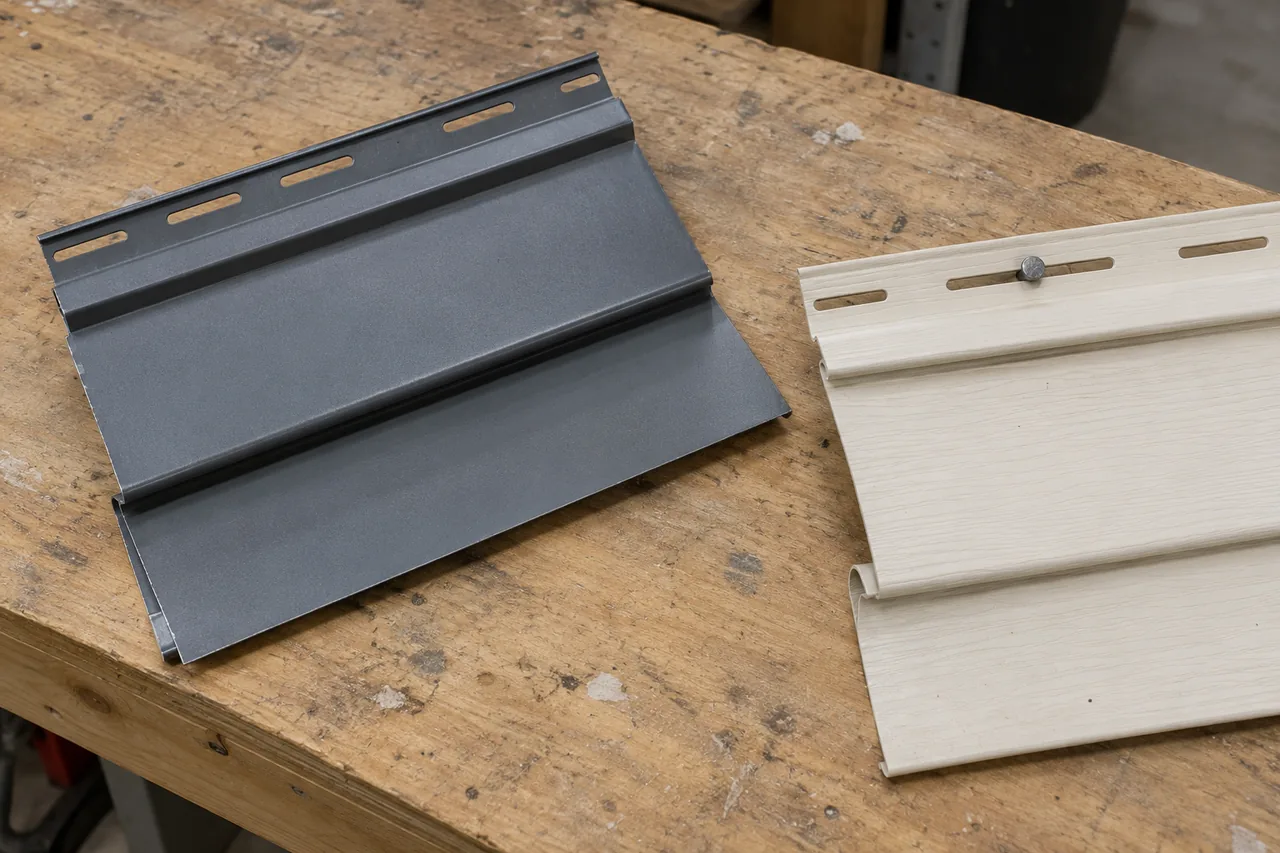
This page compares residential horizontal steel lap siding and rigid or insulated vinyl lap siding strictly from three opened documents: the Vinyl Siding Institute (VSI) October 2020 installation manual, EDCO’s September 2022 steel siding installation guide, and Klauer Manufacturing’s steel siding maintenance page (verified 17 October 2026). None of these documents covers architectural standing-seam walls, corrugated exposed-fastener sheets, or metal composite panels, and none states material or labor prices, wind pressures, impact classes, or fire ratings. Keep those cells blank until the project submittal and local quote supply them.
Use this comparison alongside the metal cladding comparisons hub in the metal wall coverings library. House-scale system choices sit on the residential metal cladding page, and board-or-sheet trade splits sit on metal cladding vs fiber cement.
Compare the documented rules before assuming a winner
On narrow screens, swipe the table horizontally to read the right-hand column. Every cell below stays inside the named document and page; rows with no published value in the opened manuals stay blank so an unverified number is never copied into a specification.
| Check item | Vinyl lap siding (VSI manual, Oct. 2020) | Horizontal steel lap siding (EDCO Sept. 2022 guide; Klauer maintenance page) | Boundary to carry onto the job |
|---|---|---|---|
| Documented product scope | Rigid PVC siding certified to ASTM D3679; insulated vinyl siding certified to ASTM D7793; installation based in part on ASTM D4756 (pp. 4–5). | EDCO STEEL-KORE (28-gauge steel with a PVC finish) and ENTEX (woodgrain Texture-Plus finish) horizontal siding (p. 2); Klauer steel siding on its maintenance page. | Neither column covers corrugated sheets, standing-seam wall panels, aluminum siding, or metal composite material. |
| Fastening logic and head clearance | Hang to move freely; center fasteners in slots (except locking a long panel at one center point or top slot of vertical siding); leave about 1/32” (0.8 mm) head clearance—about the thickness of a dime (pp. 15–16, 26). | Hang on the wall and allow to float for expansion/contraction and wall irregularities; center nails in slots and leave 1/32” space between nail head and panel (EDCO, p. 8). | Do not face-nail either siding or snug the fastener head against the nailing hem. |
| End clearance at J-channels, corners, and stops | Leave at least 1/4” (6.4 mm) at all openings and stops; increase to 3/8” (9.5 mm) when installing below 40°F (4.4°C). A 12’ 6” (3.81 m) vinyl panel can move 1/2” (12.7 mm) or more (pp. 7, 15, 21). | Leave about 1/8” clearance where steel siding meets J-channels or corner posts; do not push tight into the channel (EDCO, pp. 6–8). | Vinyl requires two to three times the receiver gap of EDCO’s steel detail and a cold-weather adjustment below 40°F. |
| Starter strip gap and ground clearance | Leave 1/4” (6.4 mm) space between adjacent vinyl starter strips; keep at least 1/2” (12.7 mm) between a roof-line J-channel and shingles (pp. 18, 23). | Leave 1/8” space between steel starter strips; start the first course of steel siding a minimum of 6” above the ground (EDCO, pp. 6, 8). | Check local building code and the exact product manual for grade clearance where a document is silent. |
| Horizontal lap length and course stagger | Overlap factory-notched ends about 1” (25.4 mm); stagger laps by at least 3 courses (about 3’ / 0.91 m apart unless broken by an opening); avoid pieces shorter than 24” (610 mm); never caulk receivers or overlaps (pp. 13, 21). | Overlap panels 3/4” to 1” between nailing flanges; separate vertically aligned laps by at least 2 courses; stagger adjacent course joints by at least 16”; keep fasteners at least 6” from panel ends (EDCO, pp. 7–8). | Step splice joints away from entrances and primary sightlines so the overlap faces away from traffic. |
| Fastener spacing and stud penetration | Maximum 16” (406 mm) horizontal siding, 12” (305 mm) vertical siding, 8”–12” (203–305 mm) accessories; penetrate at least 1-1/4” (32 mm) into framing plus nailable sheathing (1-1/2" nail standard; 2" nail over insulated vinyl or old siding, pp. 13–14, 26). |
Space nails 16” on center into framing studs, working from panel center toward the ends; penetrate at least 3/4” into the stud (1-1/2" galvanized nail uninsulated; 2" galvanized nail with drop-in backer or fanfold, EDCO, p. 8). |
Confirm fastener metal compatibility and spacing in high-wind zones with the manufacturer’s code report. |
| Field cutting methods | Circular saw with fine-tooth plywood blade installed in reverse direction (“Use this method only with vinyl siding”), tin snips for vertical cuts, utility knife score-and-snap for horizontal cuts (p. 12). | Typically do not cut with heat-generating devices (circular saws or jigsaws) because heat damages the galvanized coating; notes an approved Tenryu PRF-18548BW Steel-Pro blade exception (consult manufacturer), plus guillotine crosscutters, tin snips, and electric shears (EDCO, p. 5). | Never transfer VSI’s reversed plywood-blade saw trick to steel siding. |
| Routine washing | Wash with a soft-bristle, long-handled car brush on a hose from bottom to top, rinsing on the way up; avoid stiff bristles or abrasives that alter gloss (p. 6). | Wash about once a year with mild detergent, water, a rag or nylon brush, and a garden hose; pressure washer noted only for heavy grime with no PSI stated (Klauer). | Neither source publishes a pressure-washer PSI limit; leave pressure blank unless the panel maker specifies it. |
| Surface scratches and severe damage | Blank — not covered in VSI 2020 installation manual. | EDCO (p. 11): touch-up pens only for small installation scratches (air-dry weathers differently than ENTEX); replace panels with large scratches; never spray-paint prefinished panels. Klauer: prime and gloss-paint large scratches before rust; replace panels when bare steel is exposed. | Keep EDCO’s prefinished replacement rule and Klauer’s maintenance note attached to their respective products. |
| Thermal R-value | ASTM D7793 insulated vinyl siding is defined with manufacturer-installed foam backing of at least R-2.0 (p. 4); uninsulated vinyl R-value is blank. | Blank — EDCO mentions optional drop-in insulation backer or fanfold underlayment (p. 8) without stating an R-value. | Record whole-wall thermal performance only from the project energy submittal. |
| Wind pressure, impact/hail, fire rating, and material/installed cost | Blank — not stated in the opened VSI manual. | Blank — not stated in the opened EDCO or Klauer documents. | Require product-specific test reports and itemized local quotes before filling these cells. |
Both systems hang on slotted hems, but their movement gaps differ
A recurring installation mistake happens when a crew treats steel siding as a rigid board that can be nailed tight and butted into trim, or treats vinyl siding with steel trim tolerances. Both manuals forbid tight nailing. In the October 2020 VSI manual (pages 15–16), vinyl panels hang from fasteners centered in the nailing slots with about 1/32 inch (0.8 mm) of space—roughly the thickness of a dime—between the fastener head and the vinyl. In EDCO’s September 2022 steel siding guide (page 8), steel panels are likewise hung on the wall and allowed to “float” with a 1/32-inch gap between the nail head and the panel, driven straight and level into the center of the nailing slot. EDCO gives two reasons for floating steel siding: thermal expansion and contraction, and bridging minor wall irregularities without telegraphing waves across the face.
Where the two manuals diverge is the linear allowance at panel ends and trim receivers:
- Vinyl movement and cold-weather allowance: VSI (page 7) states that vinyl siding can expand and contract 1/2 inch (12.7 mm) or more over a 12-foot-6-inch (3.81 m) length during normal year-round temperature swings. To keep panels from buckling against stops, VSI requires at least 1/4 inch (6.4 mm) clearance at all window and door J-channels, corner posts, and stops—and increases that requirement to 3/8 inch (9.5 mm) whenever the outdoor temperature at installation is below 40°F (4.4°C) (pages 15, 21). VSI also requires 1/4 inch (6.4 mm) between starter strip lengths (page 18), at least 1/2 inch (12.7 mm) between a roof-line J-channel and shingles (page 23), a minimum piece length of 24 inches (610 mm), and 3 courses of vertical separation between horizontal laps, while forbidding caulk inside receivers or at panel overlaps (page 21).
- Steel lap movement and splice spacing: EDCO’s September 2022 guide specifies about 1/8 inch clearance where steel siding enters J-channels or corner posts and 1/8 inch between steel starter strips, with the first course set at least 6 inches above the ground (pages 6–8). Horizontal steel panels overlap 3/4 inch to 1 inch measured between nailing flanges, vertically aligned splice joints must be separated by at least 2 courses with adjacent course laps staggered by at least 16 inches, and nails must stop at least 6 inches from panel ends so the overlap can flex into place (pages 7–8).
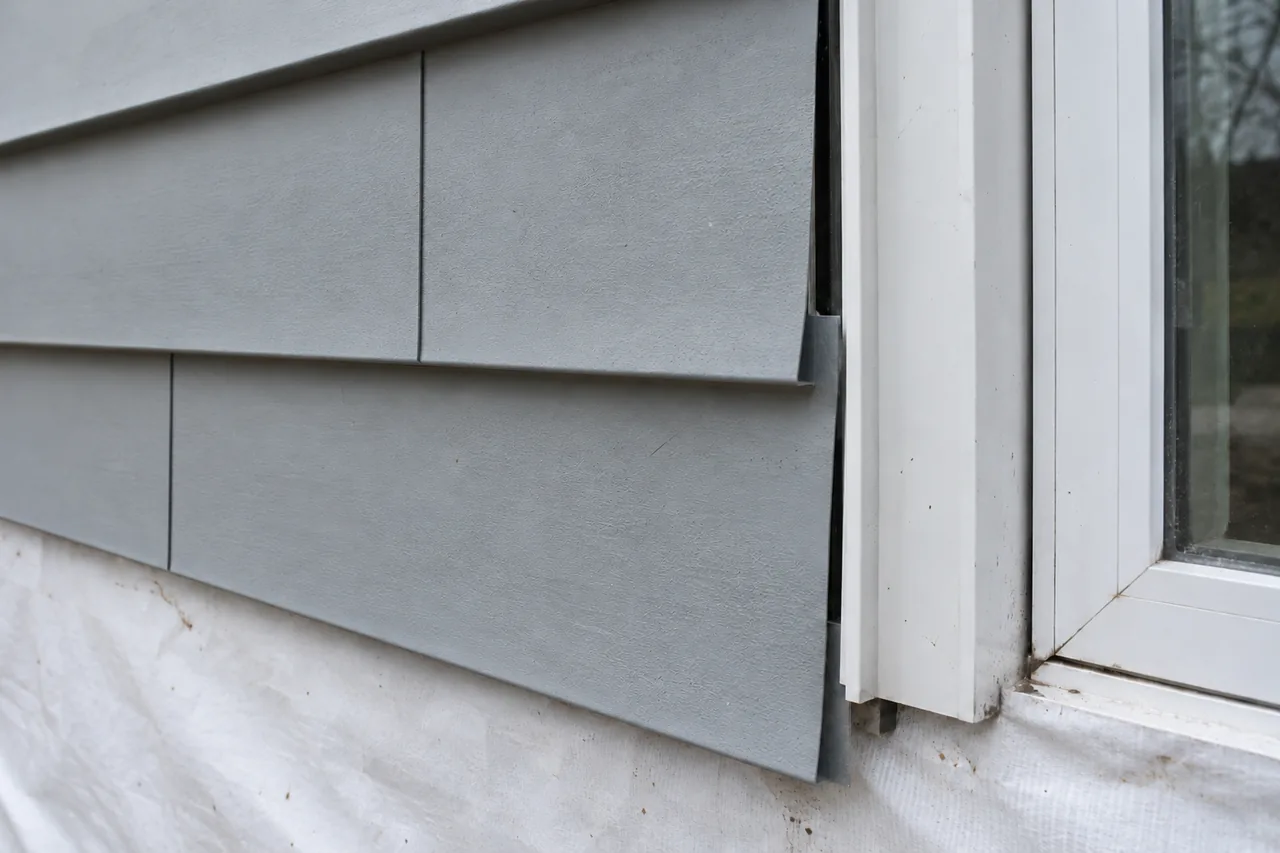
Takeaway: Verify whether the crew is building to VSI’s 1/4-inch (3/8-inch below 40°F) vinyl receiver gap or EDCO’s 1/8-inch steel receiver gap before the first starter strip and J-channel are nailed.
Field cutting rules do not cross over between vinyl and steel
Tool selection is one of the sharpest operational boundaries between the two materials. A saw method that VSI explicitly recommends for vinyl siding conflicts directly with EDCO’s coating protection rule for galvanized steel siding:
- VSI’s vinyl-only circular saw method: On page 12 of the October 2020 VSI manual, installers are told that with a power saw they should install a fine-toothed plywood blade in the reverse direction for a smoother cut, and the manual prints a direct boundary right beside that instruction: “Use this method only with vinyl siding, not with other types of siding.” In cold weather, VSI adds that moving the saw slowly through vinyl helps prevent cracking, while tin snips handle vertical cuts and a utility knife scores and snaps horizontal cuts.
- EDCO’s heat-generating saw restriction on steel: On page 5 of EDCO’s September 2022 steel siding guide, the cutting section states that steel siding should typically not be cut with heat-generating devices, such as circular saws or jigsaws, because heat damages the protective galvanized coating. The same paragraph notes an exception for an approved Tenryu PRF-18548BW Steel-Pro blade and instructs the user to consult the siding manufacturer. For non-saw cuts, EDCO lists a sharp guillotine-style cutter for cuts across the panel, tin snips for cutouts around windows, doors, and gables, and electric shears for long horizontal or flat angled cuts.
For profile-specific metal cutting rules—including why newer steel profiles restrict snips or shears across formed locks and how to clear metal swarf—use our cutting metal siding guide and the broader steel wall cladding material reference.
Washing, scratch repair, and panel replacement follow different paths
Routine dirt removal looks similar at a glance, but surface damage and recoating rules separate vinyl from factory-coated steel.
On page 6 of the October 2020 VSI manual, vinyl siding is washed with a soft-bristle, long-handled brush (such as a car-washing brush) attached to a hose. To avoid changing the glossy appearance of the vinyl, VSI warns against rubbing vigorously or using stiff-bristle brushes or abrasive cleaners, and instructs washing from the bottom to the top while rinsing on the way up to prevent dirty streaks.
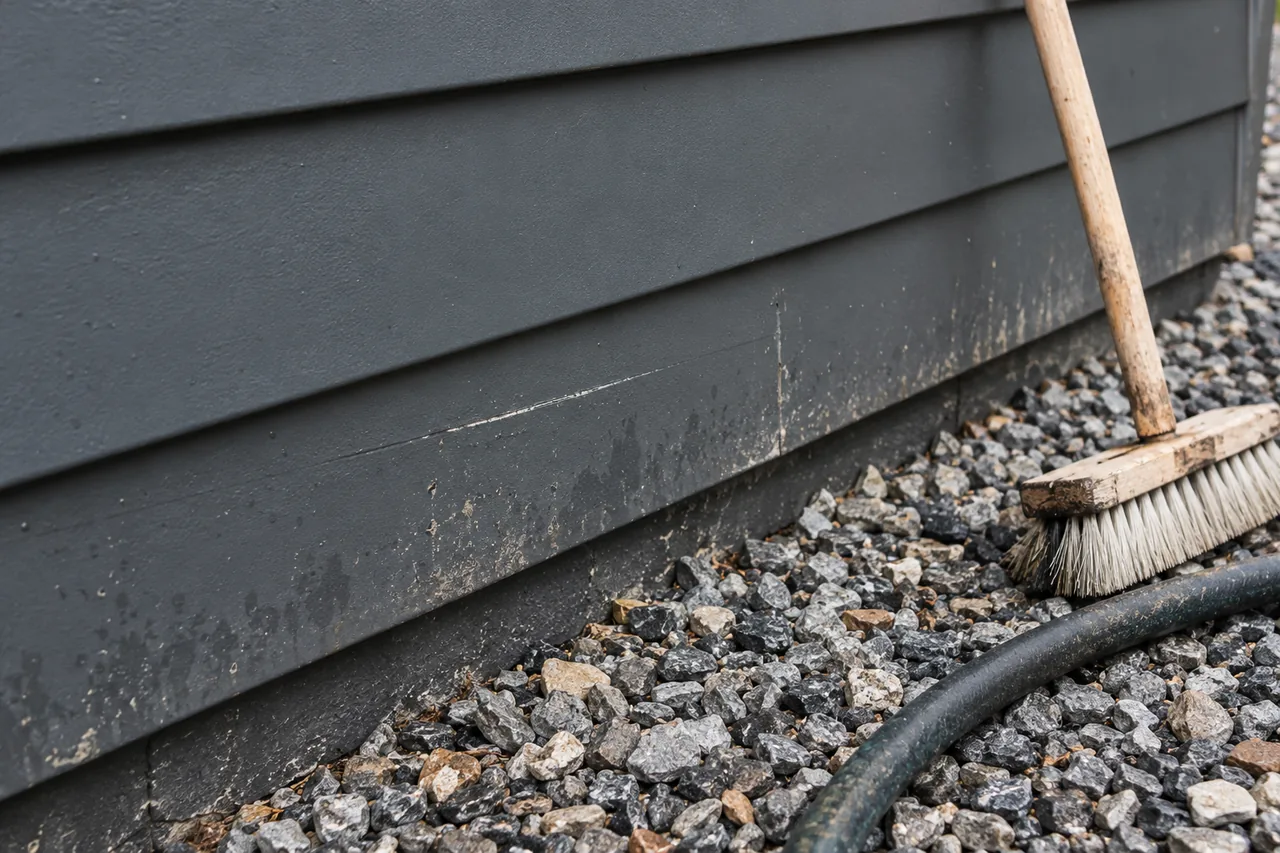
On steel siding, the two manufacturer documents read for this page divide routine washing from scratch repair and panel replacement:
- Annual washing on Klauer steel siding: Klauer’s maintenance page recommends washing steel siding about once a year in spring or summer with mild detergent and water, a rag or nylon brush, and a garden hose at any water temperature, rinsing thoroughly so soap spots do not dry on the face. It notes that dry surface dirt is not harmful if washed off when noticed, advises keeping bushes, trees, and mulch from rubbing the panels, and mentions a pressure washer only for heavy grime without stating a pressure number.
- EDCO’s touch-up pen vs replacement boundary: On page 11 of EDCO’s September 2022 guide, spray paint is restricted to pre-installation painting of accessories and must never be used on prefinished siding panels. Touch-up pens are restricted to small scratches created during installation; because air-dry touch-up paint does not weather at the same rate as ENTEX factory finishes, EDCO states that touch-up must be kept to a minimum and that panels with large scratches should be replaced rather than touched up.
- Klauer’s scratch priming and bare-steel replacement note: Klauer’s maintenance page warns that painting over its original steel siding finish can compromise that finish. For large scratches on installed Klauer panels, the page advises priming and painting the scratch with a gloss paint before rust appears (without naming a primer or paint brand). For major damage—specifically where bare steel is exposed—Klauer advises calling a siding professional, noting that replacing the affected panels will likely be recommended.
When you need to document wash solutions across other metal finishes or decide whether an existing factory coat can be repainted, use our cleaning metal wall panels and repainting metal siding guides.
How to handle metal siding vs vinyl siding cost and unverified ratings
Searches for metal siding vs vinyl siding cost or metal siding cost vs vinyl often turn up single national dollar-per-square-foot ranges that hide what actually drives a residential quote. None of the three primary documents read for this page publishes material pricing, installer labor rates, wind design pressures, hail impact classes, or fire ratings. Instead of copying an unverified range, require the bidding contractors or suppliers to itemize the variables that the installation manuals themselves expose:
- Named substrate, gauge or certification, and finish: In EDCO’s manual, STEEL-KORE is a 28-gauge PVC-coated steel panel and ENTEX uses a woodgrain Texture-Plus finish (page 2). In VSI’s manual, standard rigid vinyl is certified to ASTM D3679 and insulated vinyl is certified to ASTM D7793 with at least R-2.0 factory-applied foam backing (pages 4–5). Quotes that say only “metal siding” or “vinyl siding” omit the product tier.
- Backer board, fanfold underlayment, and fastener length: Both VSI (page 14) and EDCO (page 8) step fastener length up from 1-1/2 inches to 2 inches when installing over insulated backing, drop-in backer, or fanfold underlayment so the shank still achieves the required stud penetration (1-1/4 inches into framing plus nailable sheathing in VSI; 3/4 inch into the stud in EDCO). Whether the quote includes fanfold leveling, drop-in foam backer, or old-siding tear-off changes both material and labor totals.
- Accessory trim and replacement allowance: Steel starter strips, inside/outside corner posts, J-channels, and window/door flashings price differently from vinyl accessories, and EDCO’s rule to replace prefinished steel panels with large installation scratches (page 11) means waste and handling allowances belong on the worksheet before ordering.
Copy the check sheet below into the project record and leave cost, wind, impact, fire, and thermal cells blank until the named product submittal and local quote fill them in.
HORIZONTAL LAP SIDING COMPARISON & PRE-ORDER CHECK SHEET
Project / elevation:
Date / reviewer:

1. PRODUCT & MANUAL IN HAND
Option A (steel lap siding manufacturer, product line, gauge, finish, manual date):
Option B (vinyl siding manufacturer, ASTM D3679 or D7793 certification, manual date):

2. SUBSTRATE, BACKER & FASTENER SCHEDULE
Existing wall condition (new sheathing / tear-off / over-clad):
Underlayment or backer (weather-resistive barrier / fanfold / drop-in foam backer):
Fastener material, head diameter, and shank length (1-1/2" vs 2"):
Required framing penetration (VSI 1-1/4" framing+sheathing / EDCO 3/4" into stud / other):
Fastener spacing on center (16" horizontal / high-wind schedule if applicable):
Slot & head clearance rule verified with crew (center of slot; 1/32" head gap):

3. MOVEMENT, OVERLAP & TRIM CLEARANCES
Expected installation temperature range (below 40°F / above 40°F):
Required clearance at J-channels, corners, and stops (VSI 1/4" or 3/8" <40°F / EDCO 1/8" / other):
Starter strip end gap and minimum ground clearance:
Horizontal overlap length and minimum course/inch stagger between laps:
Confirm no caulk inside J-channel receivers or horizontal panel overlaps:

4. FIELD CUTTING, CLEANING & SCRATCH BOUNDARY
Permitted crosscut tool and rip/cutout tool from the applicable manual:
Saw restriction or named blade exception verified (no reversed vinyl blade on steel):
Annual wash method and brush type from manufacturer care guide:
Small installation scratch rule vs large scratch / bare-steel replacement rule:

5. PROJECT SUBMITTAL & QUOTE CELLS (LEAVE BLANK UNTIL VERIFIED)
Documented wind design pressure / code evaluation report number:
Documented impact / hail rating and test standard:
Documented fire classification / assembly rating:
Documented thermal R-value (product backer vs whole-wall assembly):
Itemized material cost (panels + backer + J-channel/corners/starter + fasteners):
Itemized installation labor & tear-off cost:
Decision: hold until missing manual or quote cells are resolved.
Method and scope boundaries
Updated 17 October 2026. This comparison synthesizes three public documents held in the local research archive and re-verified against their live publisher URLs on 17 October 2026: the Vinyl Siding Institute’s Vinyl Siding Installation Manual (October 2020, 52 pages), EDCO Products’ Steel Siding Installation Guide (updated September 2022, 12 pages), and Klauer Manufacturing’s Maintenance Tips for Steel Siding blog reference. Where an older or single-manufacturer guide states a rule—such as EDCO’s 28-gauge STEEL-KORE and ENTEX instructions or its named Tenryu PRF-18548BW Steel-Pro blade exception—that rule applies only to the products covered by that manual.
Always obtain the current installation manual, code evaluation report, and finish warranty for the exact siding profile on your project before cutting or fastening panels.
Frequently asked questions
Are both vinyl siding and steel lap siding hung to float on slotted nailing hems?
Yes, within the two installation manuals read for this page. The October 2020 Vinyl Siding Institute (VSI) manual and EDCO's September 2022 Steel Siding Installation Guide both tell installers not to drive fasteners tight, to center the fastener in the slot, and to leave about 1/32 inch (0.8 mm) between the fastener head and the panel so the siding can move. EDCO's guide states that its steel panels are hung on the wall and allowed to float for expansion and contraction and for wall irregularities.
Can the same circular saw setup cut both vinyl siding and steel siding?
No. VSI's October 2020 manual (page 12) describes installing a fine-toothed plywood blade in the reverse direction on a circular saw and states to use that method only with vinyl siding, not with other types of siding. EDCO's September 2022 steel siding guide (page 5) states that steel siding should typically not be cut with heat-generating devices such as circular saws or jigsaws because heat damages the protective galvanized coating, noting a named exception for an approved Tenryu PRF-18548BW Steel-Pro blade after consulting the siding manufacturer.
Why are metal siding vs vinyl siding cost cells left blank on this page?
None of the three manufacturer and trade-association documents read for this comparison—the October 2020 VSI installation manual, EDCO's September 2022 steel siding guide, or Klauer's steel siding maintenance page—publishes material prices or labor rates. Leaving material and installed cost blank prevents a generic national estimate from overriding an itemized local quote that names the exact profile, coating, insulation backer, accessory trim package, and tear-off scope.
Sources
- Vinyl Siding Installation Manual (October 2020) — Vinyl Siding Institute (VSI) Accessed October 17, 2026.
- Steel Siding Installation Guide (Updated September 2022) — EDCO Products Accessed October 17, 2026.
- Maintenance Tips for Steel Siding — Klauer Manufacturing Accessed October 17, 2026.